QUICK TAKEAWAYS
Email warmup typically takes 14 to 21 days for a new domain to safely reach 50 emails per day. To scale outreach to 200+ daily sends, a full 4 to 6-week warmup cycle is required. Readiness is confirmed by an inbox placement rate above 90% and a sender reputation score over 80.
Why Email Warmup Duration Matters
If you want to warm up email properly before scaling outreach, timing is what determines whether your campaigns land in inboxes or disappear into spam.
You can write a great cold email, target the right list, and nail your subject line. Even with the perfect opening, you might still watch everything land in spam.
That gap between effort and outcome usually comes down to one thing: your domain’s sending history.
A new domain doesn’t start from a neutral position. It starts from zero. Inbox providers treat unfamiliar senders with suspicion until behavioral patterns prove otherwise. Building that proof takes time, and there’s no shortcut around it.
Warmup isn’t just a prerequisite. It’s the stage where your sender reputation and domain reputation actually get built. Rush it, and the campaigns that follow will be fighting an uphill battle from day one.
This guide breaks down exactly how long that process should take, what signals to watch for, and what happens when senders scale before they’re ready.
The Short Answer: How Long Does Email Warmup Take?
For a new domain, the minimum warmup period is 14 to 21 days before exceeding 50 emails per day. To safely scale to 200 or more daily sends, a full warmup cycle of 4 to 6 weeks is recommended.
The exact timeline depends on your inbox placement, sender reputation scores, and how consistently engagement signals hold up throughout the process.
Why Email Warmup Duration Matters
Email warmup is the process of gradually increasing sending volume while generating positive behavioral signals — the markers inbox providers use to evaluate your domain.
The mechanism behind it is ISP trust scoring.
Gmail, Outlook, and other major providers don’t make a one-time judgment about your domain. They evaluate patterns continuously. Every email you send feeds into that evaluation. Was it opened? Replied to? Moved out of spam?
👉 Google explains these evaluation factors in its sender guidelines.
Those behavioral signals accumulate over time and shape how your future mail gets routed. Volume alone doesn’t move that score anywhere useful. Patterns do.
A domain sending 20 emails per day with consistent opens and replies looks like normal human communication. That same domain jumping to 200 sends overnight — with engagement that doesn’t keep pace — looks suspicious. That’s precisely the spam risk filters are designed to catch.
There’s also a persistent misconception about domain age. Many senders assume an older domain carries automatic trust. That’s not how ISP trust scoring actually works.
A domain that hasn’t sent recently, or one with a poor engagement history, starts from a weak position regardless of registration date. What matters is recent, consistent, positive behavior.
👉 Microsoft’s email authentication and reputation documentation reinforces this behavior-based evaluation.
Warmup gives inbox providers enough data to establish a behavioral baseline for your domain. Without it, your sending activity reads as unpredictable — and unpredictable senders get filtered.
Poor cold email deliverability almost always starts here. Not with bad copy or the wrong list. With a domain that never got the foundation it needed before volume was pushed through it.
Recommended Warmup Timeline
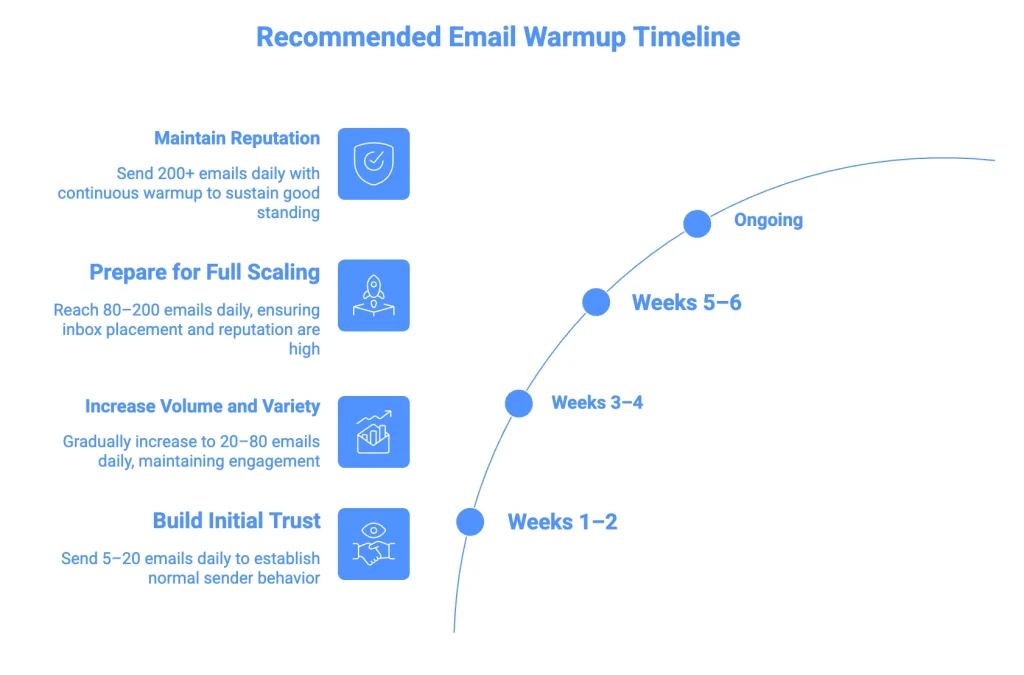
Each phase serves a distinct purpose. Skipping or compressing them tends to create problems that only surface later — usually mid-campaign.
| Phase | Week | Daily Volume | Goal |
| Phase 1 | Weeks 1–2 | 5–20 emails | Build Initial Trust |
| Phase 2 | Weeks 3–4 | 20–80 emails | Increase Volume and Variety |
| Phase 3 | Weeks 5–6 | 80–200 emails | Prepare for Full Scaling |
| Phase 4 | Ongoing | 200+ emails | Maintain Reputation with Continuous Warmup |
Phase 1: Building the Baseline (Weeks 1–2)
The first two weeks are about establishing that your domain behaves like a real sender. Volume is deliberately low. The priority is quality of engagement, not quantity.
Consistent opens, replies, and normal interaction patterns signal to inbox providers that legitimate communication is happening. Don’t make any sudden volume changes during this phase.
Phase 2: Controlled Growth (Weeks 3–4)
Volume increases, but engagement needs to keep pace. A common mistake here is assuming the process can absorb faster growth just because phase one went smoothly.
If open rates drop as volume climbs, you’re moving too fast. Inbox placement metrics should stay stable throughout.
Phase 3: Scaling Readiness (Weeks 5–6)
By now, your domain should have a stable engagement history across a meaningful sending window. Full-scale outreach becomes viable here — but only based on accumulated signals, not time elapsed alone.
Senders who hit week five and assume warmup is done are the ones who experience deliverability drops at the worst possible time.
Phase 4: Ongoing Maintenance
Warmup doesn’t have a finish line. High-volume senders keep it running in the background to protect sender reputation during increased outreach periods, list changes, or new campaign launches.
Treating warmup as a one-time setup is one of the most costly mistakes in cold email deliverability.
4 Signs Your Email Is Ready to Scale
Time is a factor in warmup, but it’s not the deciding one. The signals your domain has generated are what actually determine readiness.
- Inbox Placement Above 90%
Inbox placement rate measures the percentage of your emails that land in the primary inbox rather than spam. Consistent placement above 90% means inbox providers have established a working level of trust with your domain. - Sender Reputation Score Above 80
A score above 80 reflects a stable pattern of positive interactions and low complaint rates. Scaling from below this point is possible, but the risk is real. - No Blacklist Flags
Blacklist entries are often invisible until something visibly breaks. A domain or IP on a major blocklist may still send mail, but inbox placement quietly suffers. - Stabilized Open Rates
Open rates don’t need to be impressive before you scale. They need to be steady. Large swings from one send to the next suggest your mail is still being routed inconsistently.
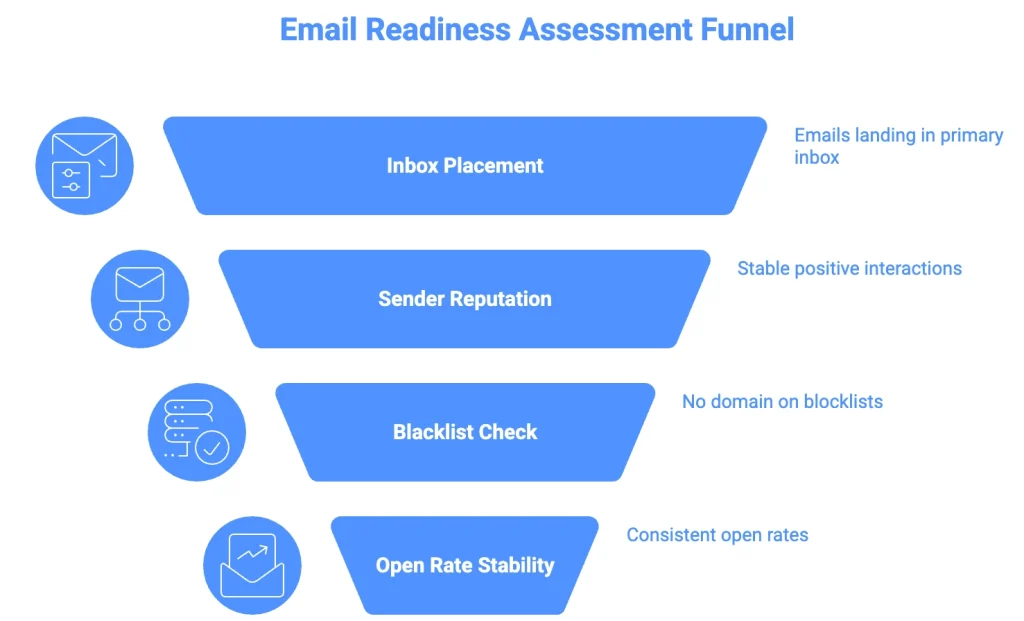
These four signals matter most when read together. A strong reputation score paired with weak inbox placement is still a problem. Look at the full picture.
The Risks of Premature Scaling
Scaling too early rarely fails immediately. That’s what makes it so easy to miss.
The early signs look fine. Emails go out. Open rates seem acceptable. A few replies come in. Campaigns appear to be running normally.
Then the slide starts.
Open rates dip. Reply volume drops. Emails begin routing to spam. It still doesn’t look like a crisis, so most senders don’t treat it as one.
But spam filter logic is cumulative. Once a portion of your sends start hitting spam, engagement from that group disappears. That missing engagement feeds back into your sender reputation, which pushes the next batch toward spam at a higher rate.
The cycle compounds. What started as a small dip becomes a systemic problem — and by the time it’s obvious enough to act on, the damage is already deep.
Spam risk isn’t always visible until it’s too late to manage cheaply. That’s the core danger of scaling without confirmed readiness signals.
Recovery takes 2 to 4 weeks. Sending volume has to drop significantly, sometimes back to warmup levels. That means paused campaigns, lost pipeline, and momentum that’s hard to rebuild.
And sometimes, the domain reputation never fully recovers. Every bit of it traces back to one decision made too early.
Manual vs. Automated Warmup
Manual warmup works. It’s just difficult to sustain consistently across 4 to 6 weeks.
The process involves daily sends, managing replies, tracking engagement, and incrementally increasing volume on a set schedule. Done with discipline, it builds a real sender reputation.
The problem is how small inconsistencies pile up. A missed day. A volume jump that was slightly too aggressive. Irregular send times. Individually, none of it seems significant — but inbox providers read consistency as a trust signal. Irregular behavior gets flagged.
Automated email warmup removes that variability. A well-built system runs on structured intervals, generates engagement across a diverse inbox network, and responds to reputation signals without any human involvement.
The quality of the automation matters, though. Some warmup tools use limited networks and repeat the same interaction patterns. Those signals are detectable, and inbox providers have grown more sophisticated about recognizing them.
What actually works is variation at scale — different providers, different timing, different engagement behavior. That combination looks indistinguishable from organic communication to a filtering algorithm.
Manual warmup for one inbox can consume 30 to 60 minutes of daily attention across a full cycle. Automated warmup runs in the background while you focus on everything else.
Email Warmup Tool: What to Look For
Choosing the right email deliverability tool matters as much as the warmup process itself. Not every option generates the same quality of reputation signal, and the gap between effective and ineffective tools shows up in placement rates.
A few factors consistently separate the ones worth using from the rest.
Network size matters. Larger networks produce more varied engagement, which reads as more natural to filtering algorithms. Activity across thousands of real inboxes carries more weight than interactions within a small, closed group.
Timing variation matters. Predictable send-and-engage patterns eventually stop looking organic. Natural timing irregularity is itself a signal of authenticity.
Inbox diversity matters. Gmail warmup needs to be credible, specifically to Gmail’s filters. The same logic applies to Outlook, Yahoo, and every major provider your campaigns will reach.
Transparency matters. If a tool doesn’t surface placement data, reputation trends, and sending activity in a usable dashboard, you’re operating without visibility. Real-time data is what makes proactive management possible.
If you want to understand how this works in practice, see:
Email Warmup Tool: How to Warm Up Email and Build Sender Trust Safely
How E-Warmup Helps You Warm Up Email Domain Reputation Faster
E-Warmup is built around the variables that actually move the needle on warmup effectiveness.
Setup takes around 25 seconds. Connect your inbox and the system starts immediately — no configuration overhead, no manual schedules to set.
The warmup network draws from over 40,000 real email accounts across multiple providers. The engagement signals these accounts generate — opens, replies, inbox moves — are authentic. Inbox providers process them the same way they process organic mail.
As an automated email warmup platform, E-Warmup adjusts sending volume dynamically based on your sender reputation. Improving signals trigger volume increases. Detected spam risk triggers a pullback before damage builds. That adaptive behavior protects against the sudden spikes that cause the most damage.
The dashboard shows inbox placement rates, domain reputation trends, and deliverability metrics in real time. When your metrics cross scaling-readiness thresholds, you see it clearly — no guesswork, no estimating based on calendar days.
For teams running multiple inboxes, the monitoring scales cleanly. Each inbox runs as its own independent reputation-building process.
Pre-Send Warmup Checklist
Before increasing outreach volume, run through this list:
- Warmup completed (minimum 14–21 days, ideally 4–6 weeks)
- Daily sending volume increased gradually across each phase
- Inbox placement consistently above 90%
- Sender reputation score above 80
- No blacklist listings on major blocklists
- Open rates stable across recent sends
- Warmup still running in the background
One gap raises risk. Multiple gaps make results unpredictable.
Frequently Asked Questions (FAQ)
Warmup Defines Whether Your Outreach Works
The copy, the targeting, the sequencing — all of it depends on one thing happening first: your emails actually reaching the inbox.
Warmup is what makes that possible. It’s the behavioral history that tells inbox providers your domain belongs in the inbox, not the spam folder. Without it, everything else is optimized for an audience that never sees it.
Build the foundation first. Give the process the time it needs. Scale when the data says you’re ready.
Or skip the guesswork entirely.

This breakdown of warmup timelines really resonates with what we’ve seen in practice—especially the part about needing 4-6 weeks for higher volume sends. It’s a helpful reminder that skipping the warmup phase often leads to deliverability issues down the line, no matter how compelling your message might be. Thanks for the clear, actionable guidance on building sender reputation safely.