
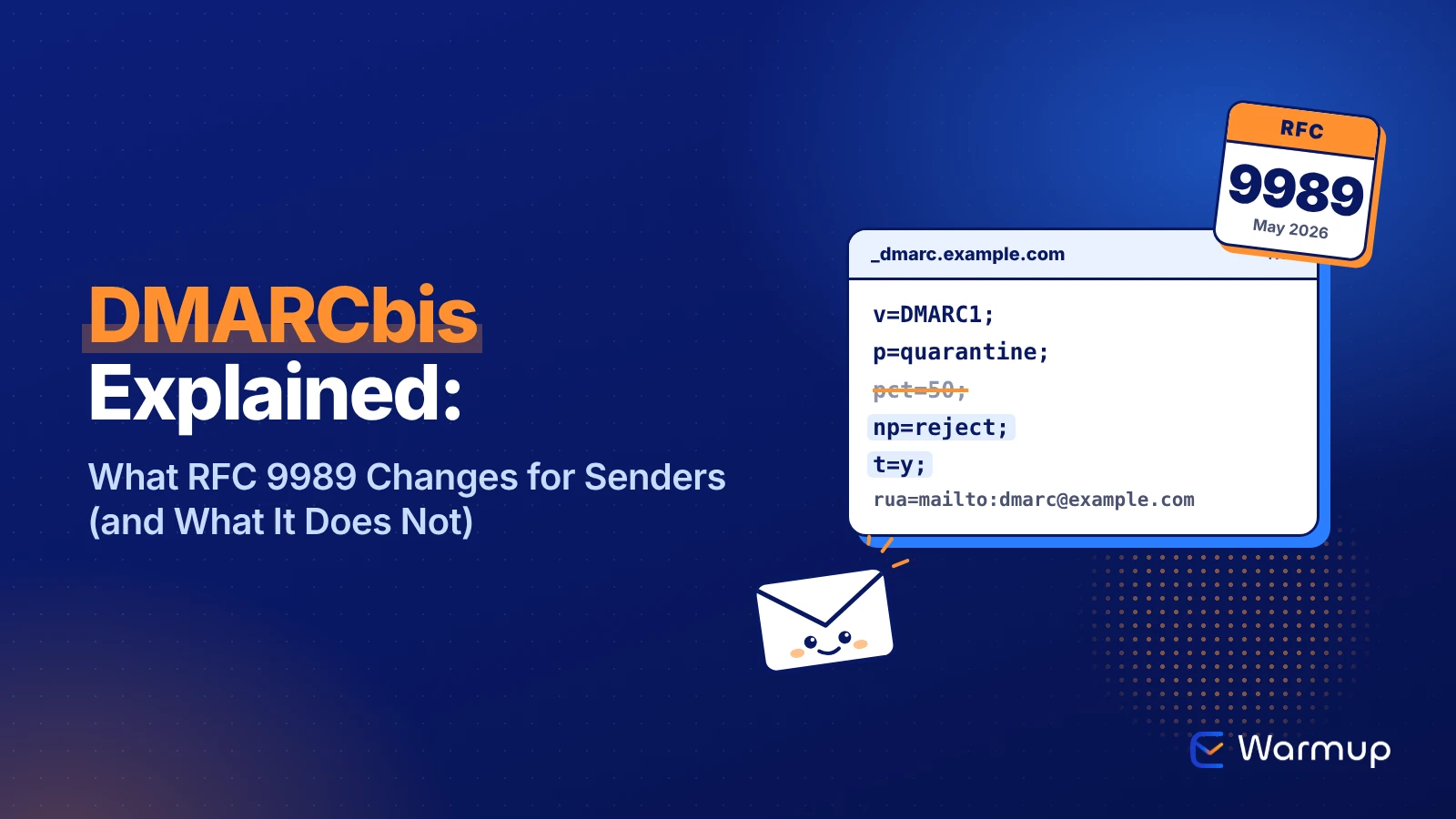
DMARCbis is the updated DMARC standard, published in May 2026 as RFC 9989, with reporting split into RFC 9990 and RFC 9991. It replaces RFC 7489, adds the np, psd and t tags, retires pct, rf and ri, and swaps the Public Suffix List for a DNS tree walk. Your existing v=DMARC1 record keeps working.
Key Takeaways
- DMARCbis is now a Standards Track protocol. RFC 7489 was only Informational.
- Nothing breaks today. Records still start with v=DMARC1, and the version number didn’t change.
- The pct tag is historic. The new t tag covers the testing use case, with only two values: y or n.
- The np tag sets a policy for subdomains that don’t exist, which is where a lot of spoofing happens.
- RFC 9989 tells receivers not to reject mail on p=reject alone, and says general-purpose mail domains shouldn’t publish it.
You probably set up your DMARC record once, checked that Gmail stopped complaining, and moved on. That was the right call. For most of the last decade, nothing in the DMARC spec gave you a reason to touch it again.
Then, in May 2026, the IETF published DMARCbis. It’s the first official rewrite of DMARC since RFC 7489 came out in 2015, and it’s now a real standard, not an informational note.
The headlines made it sound bigger than it is. Your existing record still works, and Google, Yahoo and Microsoft haven’t changed their sender rules because of it.
A few things did change, though, and two of them affect how you should write a DMARC policy from now on. This guide covers what moved, what didn’t, and the short list of edits worth making.
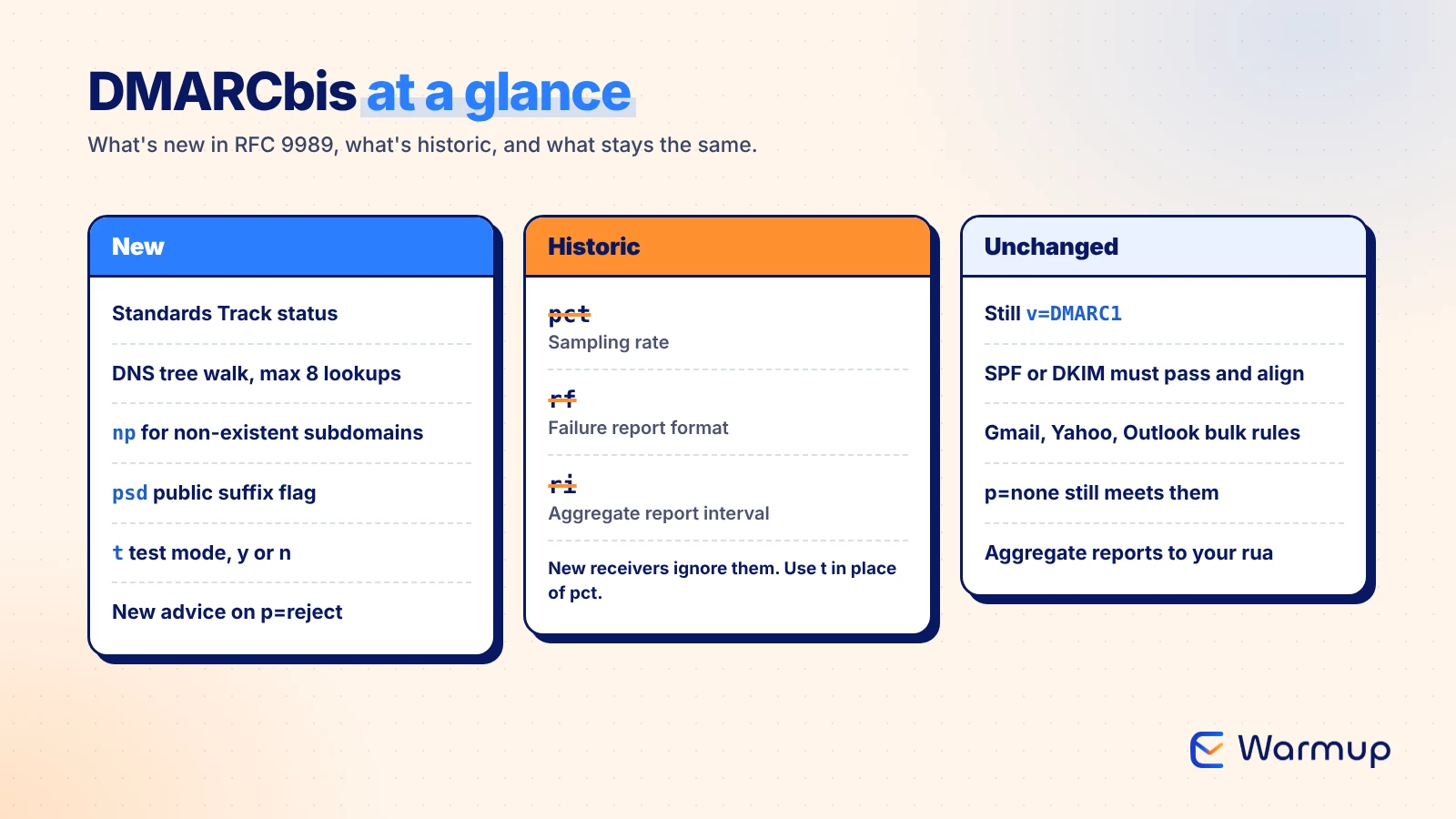
DMARCbis at a Glance: The 7 Changes in RFC 9989
DMARCbis is three documents. RFC 9989 covers the protocol itself, RFC 9990 covers aggregate reports and RFC 9991 covers failure reports. Together they obsolete RFC 7489, and RFC 9989 also obsoletes RFC 9091, the experimental spec for public suffix domains.
| # | Change | What it means for you |
|---|---|---|
| 1 | Standards Track status | DMARC is now an official internet standard |
| 2 | DNS tree walk replaces the Public Suffix List | Receivers find your policy by walking up DNS, capped at 8 lookups |
| 3 | New np tag | A policy for subdomains that don’t exist |
| 4 | New psd tag | Mostly for registries; leave it out on a normal domain |
| 5 | New t tag | Test mode that replaces the old pct workflow |
| 6 | pct, rf and ri are historic | New receivers ignore them |
| 7 | New guidance on p=reject | General-purpose mail domains shouldn’t publish it |
What Changed: Tree Walk, np, psd and t
Four mechanical changes matter, and only one of them (np) is something most senders should act on this quarter.
The DNS tree walk
Under RFC 7489, receivers used the Public Suffix List to work out your organizational domain. DMARCbis replaces that with a DNS tree walk. The receiver checks for a _dmarc record at the sending domain, then walks up one label at a time. RFC 9989 caps the walk at eight DNS queries, however long the domain is.
For a normal company domain like mail.example.com, you won’t see a difference. The tree walk matters for unusual setups, such as companies that delegate subdomains to separate business units.
The np tag (non-existent subdomains)
The np tag sets the policy for subdomains that don’t exist in DNS at all, such as invoices.example.com when you never created it. Attackers like those names because they look official and nobody monitors them.
If you leave np out, receivers fall back to your sp tag, and then to p. So a domain at p=none is wide open on every made-up subdomain. Adding np=reject closes that gap without touching your real mail, because a subdomain that doesn’t exist never sends legitimate email.
The psd tag
The psd tag tells receivers whether a record belongs to a public suffix domain, like a country-code registry. It takes y, n or u, and u (the default) leaves it to the tree walk. Unless you run a registry, leave it out.
The t tag (test mode)
The t tag replaces the testing role pct used to play. It has two values. With t=n (the default), receivers apply your policy as written. With t=y, you’re telling receivers you’re still testing, and RFC 9989 says the policy applied to failing mail drops one level: reject becomes quarantine, and quarantine becomes none.
Two details catch people out. The t tag has no effect at p=none, and it doesn’t change your DMARC reports at all.
What Became Historic: pct, rf and ri
Three tags from RFC 7489 are gone. The IANA DMARC tag registry now lists pct, rf and ri as historic, while np, psd and t are active.
| Old tag | What it did | Status now |
|---|---|---|
| pct | Applied the policy to a percentage of failing mail | Historic, use t instead |
| rf | Set the failure report format | Historic |
| ri | Set the aggregate report interval | Historic |
The pct tag went because it rarely worked as written. RFC 9989 says receivers usually didn’t apply it accurately unless it was set to 0 or 100, which is why t only offers y and n. Those two values mirror pct=0 and pct=100.
You don’t need to delete these tags today. During the transition, some receivers still follow RFC 7489 and will keep honoring pct, while receivers on RFC 9989 ignore it and read t instead.
If you’re mid-rollout at pct=50, that means you get different behavior at different mailbox providers, which is the main reason to finish the rollout instead of parking it.
What DMARCbis Does Not Change
Plenty stayed exactly where it was, and that’s the part most summaries skip:
- The version tag. Records still begin v=DMARC1. There is no DMARC2.
- SPF DKIM DMARC basics. DMARC still passes when SPF or DKIM passes and aligns with your From domain.
- Mailbox provider rules. Google’s sender guidelines still require a DMARC record from bulk senders, and p=none is still enough to meet them. Yahoo and Microsoft’s requirements are also unchanged.
- Your rua address. Aggregate reports still arrive daily in most cases, though RFC 9990 moves them to a new XML namespace (urn:ietf:params:xml:ns:dmarc-2.0).
One reporting change does catch people: if your rua address sits on another domain, RFC 9990 requires that domain to publish an authorization record, or receivers must ignore the address. Most DMARC reporting services already handle this, but it’s worth confirming.
The new advice on p=reject
This is the change with the biggest real-world effect.
RFC 9989 says domains used for general-purpose email “SHOULD NOT deploy” p=reject, because rejection breaks mailing lists, forwarders and role aliases. It also says receivers “MUST NOT reject” mail based on p=reject alone, and must treat that failing mail as quarantine unless other signals justify a rejection.
Domains that do publish p=reject “MUST NOT rely solely on SPF” to pass DMARC. In practice, that means aligned DKIM on every sending source. For a transactional or marketing-only domain where nobody posts to mailing lists, p=reject is still a reasonable end state.
What You Need to Do (Short List)
Most domains need four small edits, and none of them is urgent enough to break a send over.
| Step | Do this | Why |
|---|---|---|
| 1 | Add np=reject | Blocks spoofing on subdomains that don’t exist |
| 2 | Replace pct with t=y while testing | pct is historic and inconsistent |
| 3 | Remove rf and ri when you next edit | New receivers ignore them |
| 4 | Confirm aligned DKIM on every sender | Required if you publish p=reject |
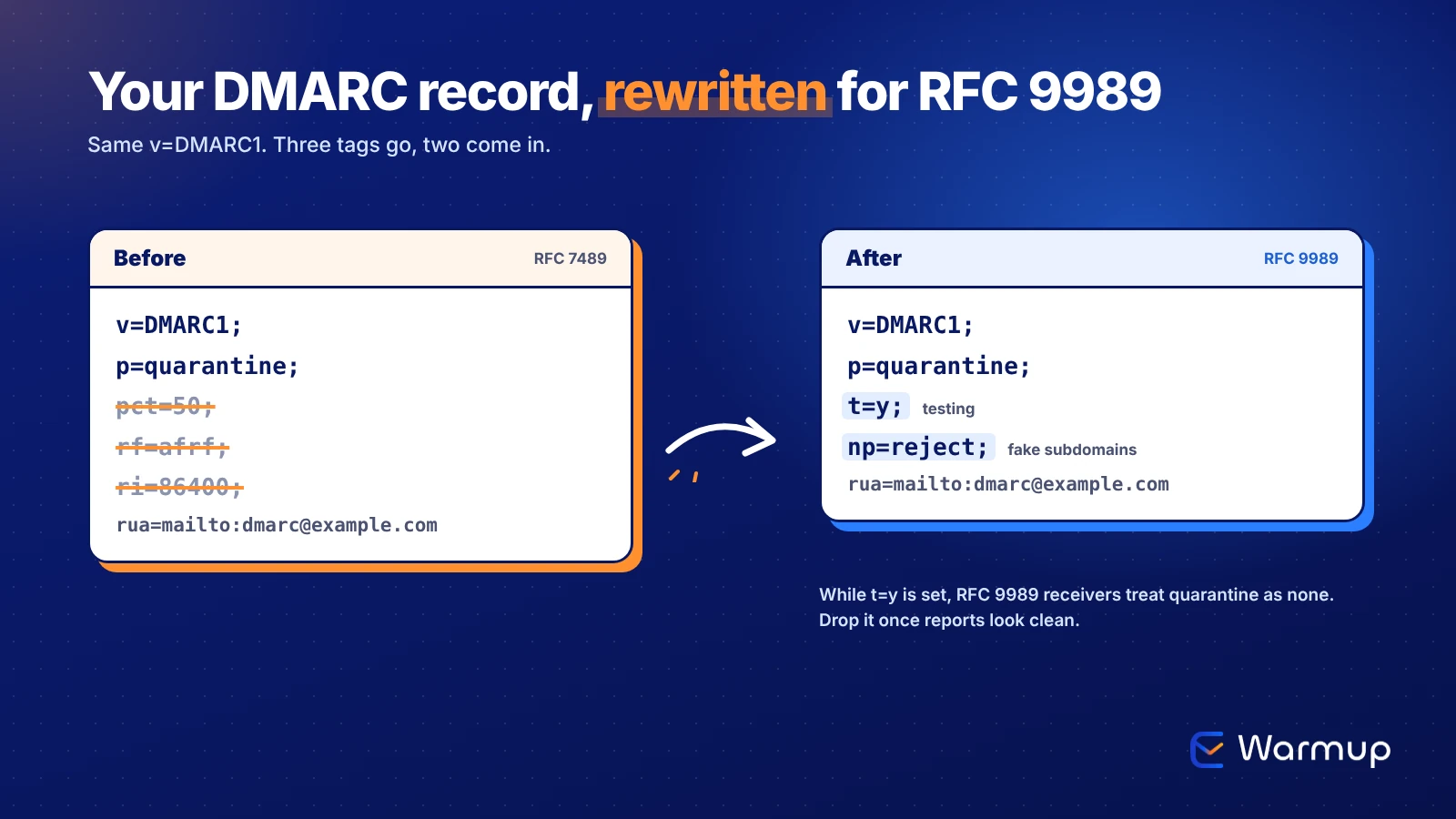
A typical record under RFC 7489 looks like this:
v=DMARC1; p=quarantine; pct=50; rf=afrf; ri=86400; rua=mailto:[email protected]
Rewritten for RFC 9989, it becomes:
v=DMARC1; p=quarantine; t=y; np=reject; rua=mailto:[email protected]
While t=y is set, receivers on RFC 9989 treat that quarantine as none. When your reports show clean results, drop t=y and the policy applies in full.
The free DMARC Record Generator builds the new syntax for you. If your record is still stuck at p=none, our guide to fixing “DMARC policy not enabled” walks through the move to enforcement.
Authentication tends to drift after a change like this, when a new tool sends without DKIM or someone edits DNS by hand. E-Warmup’s Deliverability Agent flags missing or failing DMARC, SPF and DKIM records per mailbox, on every plan including Free Forever, so you catch the drift before it shows up in placement.
What to Ask Your Email Vendors
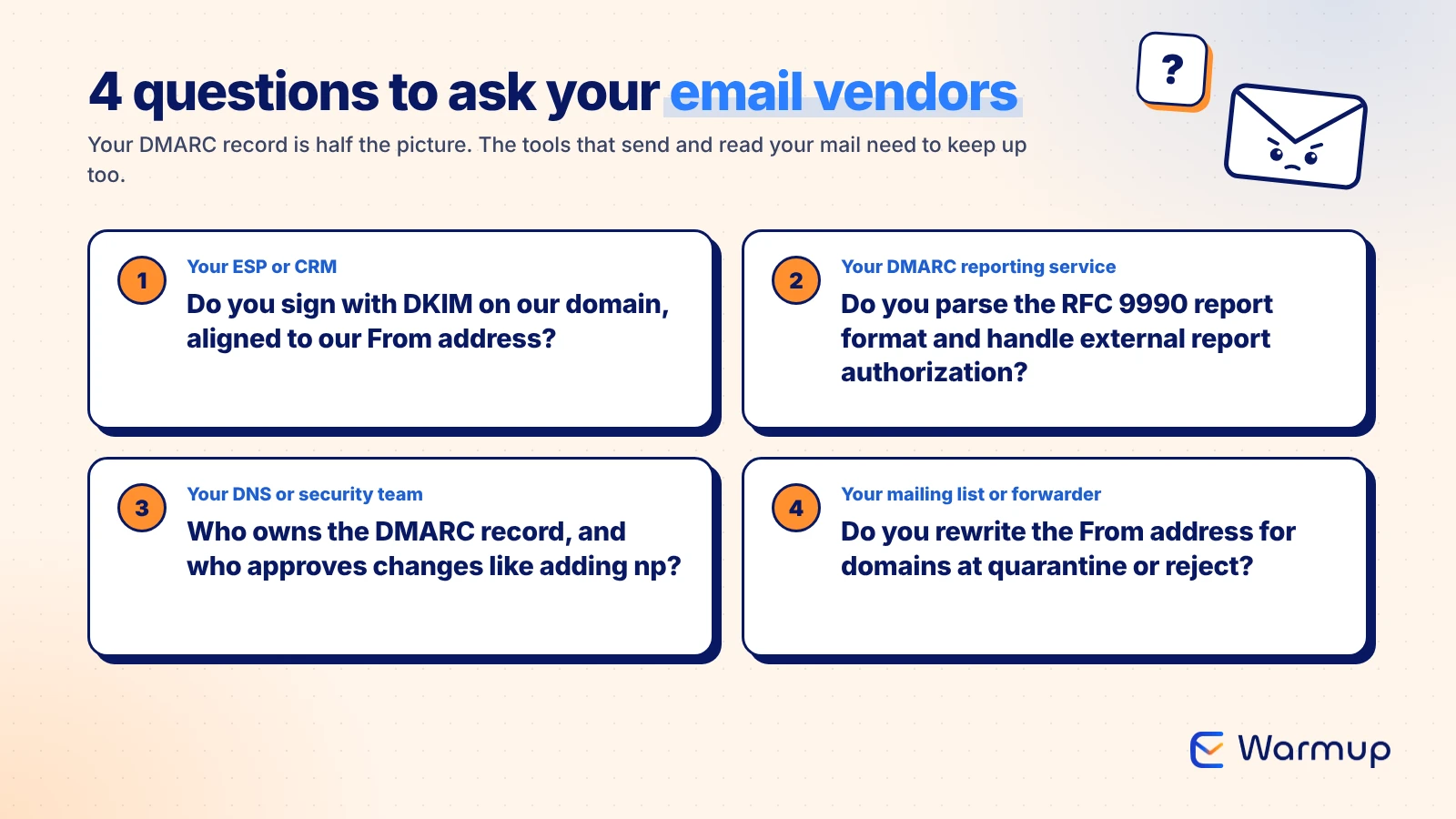
Your record is only half the picture. The tools that send and read your mail need to keep up too. Ask each one these questions:
- Your ESP or CRM: Do you sign with DKIM on our domain, aligned to our From address? Under RFC 9989, p=reject can’t rely on SPF alone.
- Your DMARC reporting service: Do you parse the RFC 9990 report format and namespace, and do you handle the external report authorization record?
- Your DNS or security team: Who owns the DMARC record, and who approves changes like adding np?
- Your mailing list or forwarding provider: Do you rewrite the From address for domains at p=reject or p=quarantine?
If a vendor can’t answer the DKIM question clearly, hold off on p=reject for that domain. Our SPF, DKIM and DMARC guide covers how alignment works if you need to check it yourself.
FAQ
What is DMARCbis?
DMARCbis is the updated DMARC standard, published by the IETF in May 2026 as RFC 9989, with reporting defined in RFC 9990 and RFC 9991. It replaces RFC 7489 and moves DMARC to the Standards Track. Records still use v=DMARC1.
Do I need to change my DMARC record for RFC 9989?
No, your current record keeps working. Adding np=reject and replacing pct with the t tag are the two edits worth making, and you can remove rf and ri the next time you edit the record.
What does the DMARC np tag do?
The np tag sets the DMARC policy for subdomains that don’t exist in DNS. If it’s missing, receivers use your sp policy, then your p policy. Setting np=reject blocks spoofed mail from made-up subdomains without affecting real ones.
Is the pct tag still supported?
pct is now historic in the IANA DMARC registry, so receivers that follow RFC 9989 ignore it. Receivers still on RFC 7489 may keep honoring it during the transition. For testing, use t=y instead, which drops your policy one level.
Should I still use p=reject?
For transactional or marketing-only domains, p=reject is still reasonable, as long as every sender passes aligned DKIM. RFC 9989 says general-purpose mail domains, where people post to mailing lists, should not publish p=reject, and p=quarantine is the safer end state there.
Does DMARCbis change Gmail, Yahoo or Outlook requirements?
No. Bulk sender rules at Gmail, Yahoo and Outlook still require SPF, DKIM and a DMARC record, and p=none still meets them. DMARCbis changes the standard, not those providers’ published requirements.
Keep Email Authentication Healthy, Free Forever
DMARCbis doesn’t ask much of you: add np, swap pct for t, and make sure DKIM is aligned everywhere you send. The bigger risk is the slow drift that happens between edits, when one new tool or DNS change breaks email authentication without anyone noticing.
E-Warmup monitors SPF, DKIM and DMARC for every connected mailbox and tells you in plain English when something fails. Start for free. No credit card required.

Related Reading
- SPF, DKIM and DMARC: The Full Email Authentication Guide: how the three records work together.
- DMARC Policy Not Enabled and How to Fix It: moving from p=none to enforcement.
- Email Deliverability Updates for Q4 2026: DMARCbis alongside this quarter’s other changes.
