Most warmup tools work the same basic way. They connect to your mailbox, send messages from your address, and rely on a network of real inboxes to open, reply, and mark those messages as important.
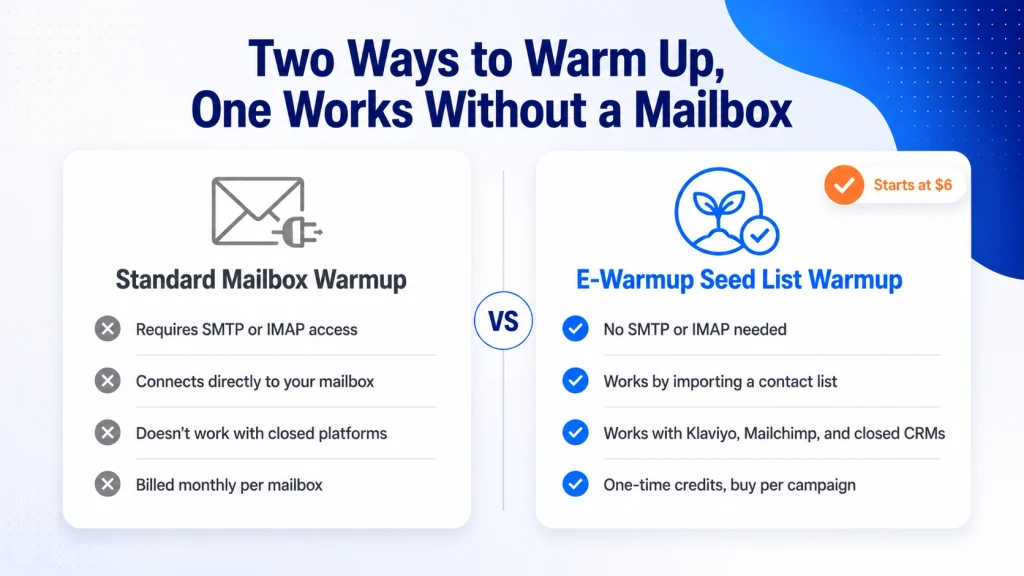
That model has one requirement baked in. It needs SMTP or IMAP access to your mailbox.
If you’re sending through Klaviyo, Mailchimp, Shopify, ActiveCampaign, or dozens of other platforms, that access doesn’t exist. No SMTP? Warm up anyway.
E-Warmup’s Seed List Warmup is built specifically for this gap, and you buy it per campaign, not per month.
Why Standard Warmup Can’t Touch These Platforms
Most email marketing platforms, CRMs, and ecommerce messaging tools are closed systems. You configure a sending domain, but the actual sending happens on infrastructure you don’t have direct access to.
A conventional warmup tool needs to connect to your mailbox to send warmup traffic and read replies. If your platform doesn’t expose SMTP or IMAP, there’s simply nothing for the tool to connect to.
This isn’t a small edge case. Klaviyo, Shopify, Mailchimp, ActiveCampaign, HubSpot, Substack, and beehiiv all fall into this category, along with most modern ESPs and CRMs.
The reputation problem doesn’t disappear just because the tool can’t reach it. A new sending domain, a fresh dedicated IP, or a list that’s gone quiet for months will still land in Promotions or Spam, regardless of which platform sends it.
What E-Warmup’s Seed List Warmup Actually Does
Seed List Warmup works around the email warmup without SMTP requirement entirely. Instead of connecting your mailbox, E-Warmup gives you access to curated lists of real, engaged seed inboxes across major providers.
You download the list, import it into your platform as a campaign audience, and send to it like any other segment. The seed inboxes open, read, click, recover emails from spam, and mark messages as important.
Those actions generate authentic engagement signals. Inbox providers read those signals the same way they’d read engagement from any real recipient, and your sender reputation, domain, and IP health improve accordingly.
Email Seed List Warmup vs Inbox Placement Testing
These two get confused constantly, and they solve different problems.
Inbox placement testing is a diagnostic. You send one campaign to a seed list and get a report showing where it landed. It tells you the state of your reputation right now. It doesn’t change anything on its own.
E-Warmup’s Seed List Warmup is a treatment. The seed inboxes actively engage over a sustained period, opening, reading, replying, rescuing messages from spam, and that sustained engagement is what actually teaches inbox providers to trust you.
A single placement test is a snapshot. Ongoing Seed List Warmup is the process that improves what that snapshot shows over time.
Who Actually Needs This
Ecommerce and DTC brands. If your flows and campaigns run through Klaviyo, Shopify, or a similar platform and your emails are landing in Promotions instead of Primary, E-Warmup’s Seed List Warmup builds the engagement history that moves them.
Newsletter operators and creators. A new Substack, beehiiv, or Kit publication starts with zero sending history. Warming the domain before your first real send protects your open rates from day one.
Teams on a closed CRM. HubSpot, Marketo, and Salesforce Marketing Cloud handle sending internally. Seed lists are the only realistic way to warm those sends.
Anyone launching a new domain or IP, or recovering from a drop. A fresh domain has no reputation to lean on. A domain recovering from a blacklist hit or a period of low engagement needs the same kind of consistent, positive signal rebuilt from scratch.
How It Works, Step by Step
The process is the same regardless of which platform you’re sending from. Here’s the full step-by-step breakdown if you want to see it directly from the source.
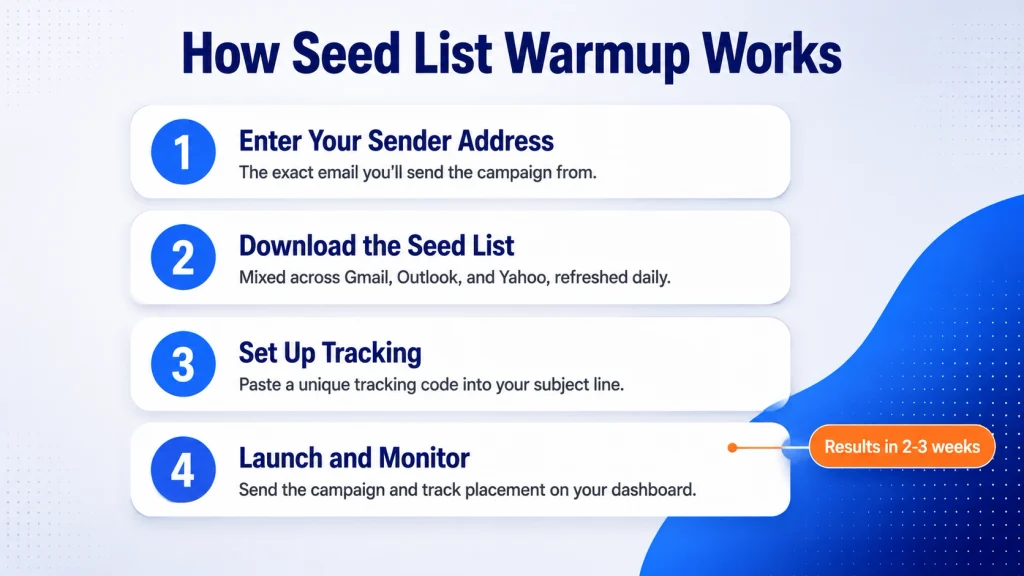
Enter your sender address. This is the exact email address you’ll use to send the campaign from your ESP.
Download the seed list. Lists are mixed across Gmail, Outlook, and Yahoo, and support both B2B and B2C sending. Download a fresh list before each new campaign, since the list rotates daily.
Set up tracking. A unique tracking code from your E-Warmup dashboard gets pasted into your email body, which lets the system detect when your emails actually reach the seed list.
Launch and monitor. Send the campaign from your platform, start the warmup on your E-Warmup dashboard, and track engagement and placement as the seeds interact with your emails.
How Credits Work
E-Warmup‘s Seed List Warmup runs on one-time credit packs, not a subscription. Buy per campaign, not per month.
Each seed costs roughly 11 to 12 cents, and pricing steps down slightly as you buy more:
- 50 seeds — $6
- 100 seeds — $11
- 200 seeds — $19
- 400 seeds — $28
- 600 seeds — $37
- 800 seeds — $46
- 1,000 seeds — $55
- Custom / DFY packs — talk to E-Warmup support for a quote
Credits never expire, and they’re separate from your mailbox plan. You can buy seed credits on any E-Warmup plan, including Free Forever, and they don’t count against your connected-mailbox limits.
The 50-seed pack at $6 is a genuinely low-risk way to test the process on a single campaign before committing to a larger list.
Seed List Warmup FAQ
Does E-Warmup’s Seed List Warmup work if my platform has no SMTP access?
Yes. That’s exactly what it’s built for. The only requirement is the ability to import a list of contacts and send to it, which almost every modern ESP, CRM, and newsletter platform supports.
Will seed emails hurt my open rates or engagement metrics?
Seed addresses engage with your mail, so they register as active subscribers inside your platform. Keeping them in a dedicated segment lets you exclude them when reporting on your real campaign performance.
How long does it take to see results?
Most senders see placement improve within two to three weeks of consistent sending. A badly damaged domain takes longer to recover, while a brand-new domain often moves faster.
Can I use Seed List Warmup alongside E-Warmup’s mailbox warmup?
Yes, and many teams do exactly that. Mailbox warmup handles cold outreach sent through a connected inbox, while seed lists handle whatever runs through a closed platform. The two are independent and reinforce each other, both running inside the same E-Warmup account.
How much does a small first campaign cost?
The smallest E-Warmup pack is 50 seeds for $6, which is enough to get a real placement read and start building reputation before you commit to a larger list.
The Bottom Line
Standard mailbox warmup only works where there’s a mailbox to connect to. E-Warmup’s Seed List Warmup exists for everything else: the ecommerce flows, the newsletter platforms, the closed CRMs, and any domain that needs to build reputation without SMTP access.
Start with a smaller pack to establish a baseline, then scale up as you see how placement responds.