

A handful of numbers explain most of what changed in deliverability this year. Some are encouraging. Others are warning signs disguised as routine benchmark updates.
If you send cold outreach, newsletters, or transactional email at any volume, your email deliverability rate is being shaped right now by shifts most senders haven’t caught up to yet.
Postmaster Tools changed. DMARC enforcement is still lagging badly behind adoption. Here are 15 numbers worth knowing, each one sourced directly to Google, Validity, or Valimail so that you can verify them yourself.
The 15 Email Deliverability Statistics Shaping Your Email Deliverability Rate in 2026
1. Global inbox placement climbed to 87.2% in 2025
The Validity 2026 Email Deliverability Benchmark Report found the average global inbox placement rate reached 87.2% in 2025, a 3.7% improvement year over year.
The gain was driven mostly by fewer emails getting blocked or rejected outright, not by fewer emails landing in spam.
2. Gmail’s average placement rate rose to 89.8%
Gmail, the largest mailbox provider at 42.9% global market share, posted an average inbox placement rate of 89.8% in 2025, the highest of any major provider, according to the same Validity report.
3. Microsoft posted the lowest placement rate among major providers, at 75.6%
Microsoft’s average inbox placement trailed the other major providers at 75.6% in Validity’s most recent data, with spam placement rates on Microsoft’s network exceeding 14%, the highest of any major mailbox provider.
4. Asia Pacific remains the lowest-performing global region
Validity’s benchmark data has consistently placed Asia Pacific’s inbox placement rate around 78%, the weakest of any major world region tracked in the report.
[IMAGE ASSET: stat callout block, global and regional inbox placement rate comparison]
5. Gmail and Yahoo require DMARC for bulk senders
Domains sending more than 5,000 messages a day to Gmail addresses must publish a DMARC record, per Google’s bulk sender guidelines. This requirement has been in force since 2024.
It remains a baseline compliance check every high-volume sender needs to clear, cold outreach included.
6. Bulk senders must keep spam complaints under 0.3%
The same Google guidelines cap spam complaint rates at 0.3% for domains sending over 5,000 emails daily.
Cross that line and Gmail can start bulk filtering the entire sending domain, not just the individual flagged messages.
7. 78% of domains publish DMARC, but only 42% actually enforce it
Valimail’s 2026 State of DMARC Report found DMARC record adoption has climbed to 78% of tracked domains worldwide.
But enforcement, meaning a policy actually set to quarantine or reject, sits at just 42%, a gap Valimail calls the “Enforcement Gap.” Most domains with DMARC are still just watching, not blocking.
8. 22% of domains still have no valid DMARC record at all
Despite years of mailbox provider pressure, Valimail’s 2026 report found more than a fifth of tracked domains still haven’t published a DMARC record in any form.
If you haven’t checked yours, E-Warmup’s free DMARC Record Generator walks through policy selection and reporting setup in under a minute.
9. Google retired the original Postmaster Tools reputation dashboards
Google’s own Postmaster Tools deprecation notice confirms the original Domain Reputation and IP Reputation dashboards are being retired entirely, replaced by Postmaster Tools v2.
The new version shifts the framing from a reputation label to compliance-based metrics, including authentication status and spam rate.
[IMAGE ASSET: comparison table, what Postmaster Tools v1 showed vs what v2 tracks instead]
10. A Sender Score below 60 cuts inbox placement below half
Validity’s Sender Score Benchmark research found that senders scoring below 60 see less than half their email placed in the inbox across Gmail, Microsoft, and Yahoo.
Sender reputation isn’t a soft metric. At the low end, it directly predicts whether most of your mail even lands.
11. Microsoft caps out at 72% placement even for top-tier senders
The same Validity research found Microsoft is the hardest major provider to reach, with a maximum average inbox placement of 72%, achieved only by senders with a Sender Score above 90.
Even excellent sender reputation doesn’t guarantee the placement rate you’d see at Gmail or Yahoo.
12. B2B inbox placement can run as low as 68% once filtering layers stack up
Validity’s 2023 Email Deliverability Benchmark found B2B inbox placement could drop as low as 68% once the combined effect of hosting platform and filtering application is factored in.
This matters most for cold email deliverability specifically, since B2B outreach carries less built-in trust than opt-in marketing lists.
13. Passing SPF, DKIM, and DMARC doesn’t by itself guarantee inbox placement
Google’s own sender guidelines are explicit that authentication is a baseline requirement, not a placement guarantee.
Mailbox providers separately evaluate engagement, complaint history, and content signals, all layered on top of whether your authentication passes.
14. Valimail blocked 2.5 billion suspicious emails in 2025 alone
Valimail’s 2026 report notes the company tracked more than 2.5 billion suspicious emails on behalf of its customers in the past year, a scale that illustrates why DMARC enforcement, not just adoption, matters so much.
Every one of those attempts relied on domains that hadn’t closed the enforcement gap.
15. E-Warmup’s own network data shows a 98% inbox placement rate
Across E-Warmup’s network of 40,000+ real inboxes and 85,000+ domains, customers see a 98% inbox placement rate and an average 22.5% increase in email channel conversion rates.
These figures come directly from E-Warmup’s own platform data, not a third-party benchmark, and are included here for transparency about where they originate.
How to Check Where Your Own Numbers Stand
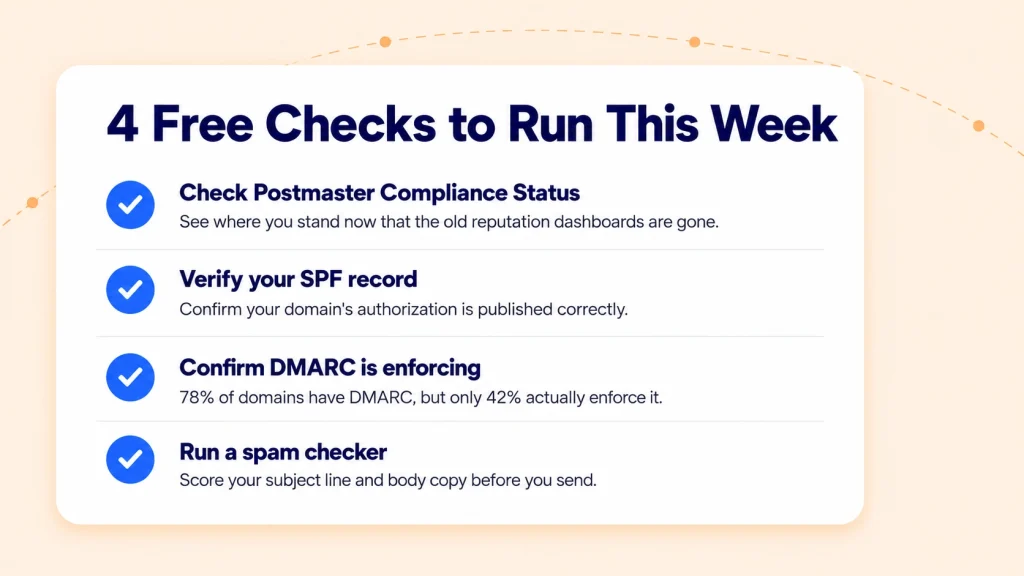
Reading benchmarks is useful, but the real value comes from checking your own sending against them. Here’s a quick sequence worth running this week.
Check your Postmaster Tools Compliance Status first. With the old reputation dashboards gone, Compliance Status is now the closest thing to a native Gmail health check available to you.
Verify your SPF record with a free generator. E-Warmup’s SPF Record Generator checks your domain’s existing DNS setup and flags whether a sending service is missing or duplicated.
Confirm your DMARC record is actually enforcing, not just monitoring. Given that 78% of domains have DMARC but only 42% enforce it, there’s a good chance yours is one of the ones still just watching.
Run your content through a spam checker before your next send. E-Warmup’s Email Spam Checker scores your subject line and body copy and flags exactly what’s driving the score.
What These Numbers Mean for Your Deliverability Strategy
Taken together, these stats point to the same conclusion from a few different angles. Authentication is table stakes, not a finish line.
Sender reputation is closer to a direct predictor of placement than most senders treat it as, especially at the low end of the scale. And cold email deliverability specifically carries more risk than opt-in marketing email, since there’s no existing relationship softening the filtering decision.
If you’re evaluating an email deliverability tool for the first time, or reassessing one you already use, these numbers are a reasonable baseline to measure against. A tool that can’t tell you your actual inbox placement rate, broken down by provider, isn’t giving you enough to act on.
What E-Warmup’s Free Forever Plan Actually Includes
Checking your numbers with the free tools above is useful, but fixing a weak sender reputation takes ongoing warmup, not a one-time check. That’s the gap E-Warmup’s Free Forever plan is built to close.
Free Forever includes one mailbox per account with standard warmup volume, and it’s genuinely free, not a trial that expires. There’s no credit card required to start, and nothing switches to paid automatically.
This is enough for a solo sender or a small team testing a single domain to start building sender reputation immediately, using the same network of 40,000+ real inboxes that E-Warmup’s paid tiers run on.
E-Warmup runs across a network of 40,000+ real inboxes, with a 98% inbox placement rate and setup that takes under 30 seconds.
Email Deliverability Statistics FAQ
What is a good email deliverability rate in 2026?
Based on Validity’s current benchmarks, an inbox placement rate above 90% is considered strong, while the global average sits closer to 87%. Anything consistently below 80% signals a problem worth investigating.
Why did Google retire the original Postmaster Tools reputation dashboards?
Google’s own documentation states the reputation data was not easily actionable for most senders and could be misleading, since reputation is only one of many factors affecting deliverability. Postmaster Tools v2 replaces it with compliance-based metrics instead.
Does passing SPF, DKIM, and DMARC guarantee inbox placement?
No. Google’s sender guidelines are explicit that authentication is necessary but not sufficient. Mailbox providers separately weigh sender reputation, recipient engagement, and complaint history.
What’s the difference between DMARC adoption and DMARC enforcement?
Adoption means a domain has published any valid DMARC record, even one set to monitor-only. Enforcement means the policy is set to quarantine or reject, meaning spoofed mail is actually blocked. Valimail’s 2026 data shows a 36-point gap between the two globally.
How does sender reputation actually affect inbox placement?
Validity’s Sender Score research shows senders scoring below 60 see less than half their mail reach the inbox across Gmail, Microsoft, and Yahoo. Reputation functions as a direct, measurable input into placement outcomes, not a vague trust signal.
Why is Microsoft harder to reach than Gmail?
Validity’s data shows Microsoft’s maximum average inbox placement tops out around 72%, even for senders with excellent Sender Scores, compared to Gmail’s 89.8%. Microsoft’s filtering weighs recipient engagement especially heavily.
What’s the difference between email delivery rate and inbox placement rate?
Delivery rate measures whether a message was accepted by the receiving server. Inbox placement rate measures whether that message actually reached the primary inbox rather than spam or another filtered folder. A high delivery rate says very little about whether recipients ever see the message.
Why does cold email deliverability carry more risk than regular marketing email?
Cold outreach reaches recipients with no existing relationship or opt-in, so there’s no engagement history softening a filtering decision. Validity’s benchmark commentary notes that even small complaint rates can meaningfully damage domain reputation for cold senders in a way they wouldn’t for an opted-in list.
How often should I check my email deliverability rate?
For active senders, checking inbox placement and Postmaster Tools Compliance Status at least monthly is reasonable. Teams running cold outreach at meaningful volume should check more frequently, since reputation can shift faster than a monthly cadence would catch.
Is E-Warmup’s Free Forever plan actually free forever, or does it convert to paid?
It’s genuinely free, forever. There’s no credit card required to sign up, and no automatic conversion to a paid plan. Free Forever includes one mailbox per account with standard warmup volume, running on the same real inbox network as every paid tier.
The Bottom Line
Your email deliverability rate isn’t determined by any single factor anymore. It’s the combined result of authentication status, sender reputation, engagement history, and content quality.
The numbers above are a starting point for checking where your own sending stands, not a target to hit once and forget about.
Related Reading
- Why Emails Going to Spam and How to Fix Email Deliverability Fast in 2026 [Solved] — Stop losing emails to spam by understanding deliverability issues, fixing sender reputation, and following proven inbox placement best practices.
- How to Warm Up an Email Account in 2026 (Step-by-Step) — Learn how to warm up an email account with authentication, gradual sending, engagement, monitoring, and automation to maximize inbox placement.
