
Automated and AI-powered are used interchangeably in warmup tool marketing, and the overlap is doing a lot of work to make two different things sound like one.
Automated email warmup just means the sending and opening happen on a schedule, without a person doing it by hand. That’s it. It says nothing about what the engagement actually looks like once it’s running.
AI Read Emulation is a claim about what happens inside that automation. Whether the opens vary. Whether anything resembling a person’s actual behavior is happening, or whether it’s the same script firing on repeat.
This post breaks down what separates the two, and why the difference shows up directly in whether your domain builds trust or gets flagged for looking automated.
What Automated Email Warmup Means on Its Own
Automated email warmup describes the delivery mechanism, not the quality of what gets delivered. A tool schedules a batch of emails between seeded inboxes, and those inboxes get marked as opened, on a timer, without anyone touching a keyboard.
That’s the entire definition. It’s the baseline every warmup tool on the market has had for years, because it’s not complicated to build. Send an email, wait a set interval, flip its status to read through an API call, repeat across a rotating pool of inboxes.
The word automated tells you the human labor has been removed. It tells you nothing about whether the resulting engagement looks like something a real inbox provider would trust.
This is where a lot of vendor pages get slippery. Automated warmup and AI-powered warmup often describe the exact same underlying mechanism, a scheduled API call, with one of them wearing a newer label.
The scheduling itself isn’t the problem. Every warmup tool, including ones built on genuine engagement modeling, still needs scheduling logic underneath it. The problem is when scheduling is the only thing happening, dressed up as something more sophisticated than it is.
What AI Read Emulation Adds on Top of Automation
AI Read Emulation starts from the same scheduling layer and adds something automation alone never touches: actual variance in how the engagement behaves.
Variable timing is the first layer. Instead of every seeded email getting opened within a narrow, predictable window, opens spread across hours, sometimes minutes, sometimes most of a day, the way a real inbox actually gets checked.
Scroll and dwell behavior is the second layer. A person opening an email doesn’t just register a read receipt and move on. They spend a few seconds on it, sometimes longer, sometimes barely a glance, and that variability in dwell time is part of what a genuine engagement signal looks like to an inbox provider.
Occasional reply threads are the third layer. Real inbox activity includes replies, not just opens. A warmup system that occasionally generates a reply, not on every message, not on a fixed schedule, is modeling something automation alone was never built to produce.
None of these three layers are things a scheduling engine adds by default. They require the system to actually model what a human’s inbox behavior looks like, moment to moment, rather than just executing a queue of send and open instructions.
This is the actual, testable difference between the two terms. Automated tells you the labor is gone. AI Read Emulation tells you the behavior underneath the automation resembles a person, not a script.
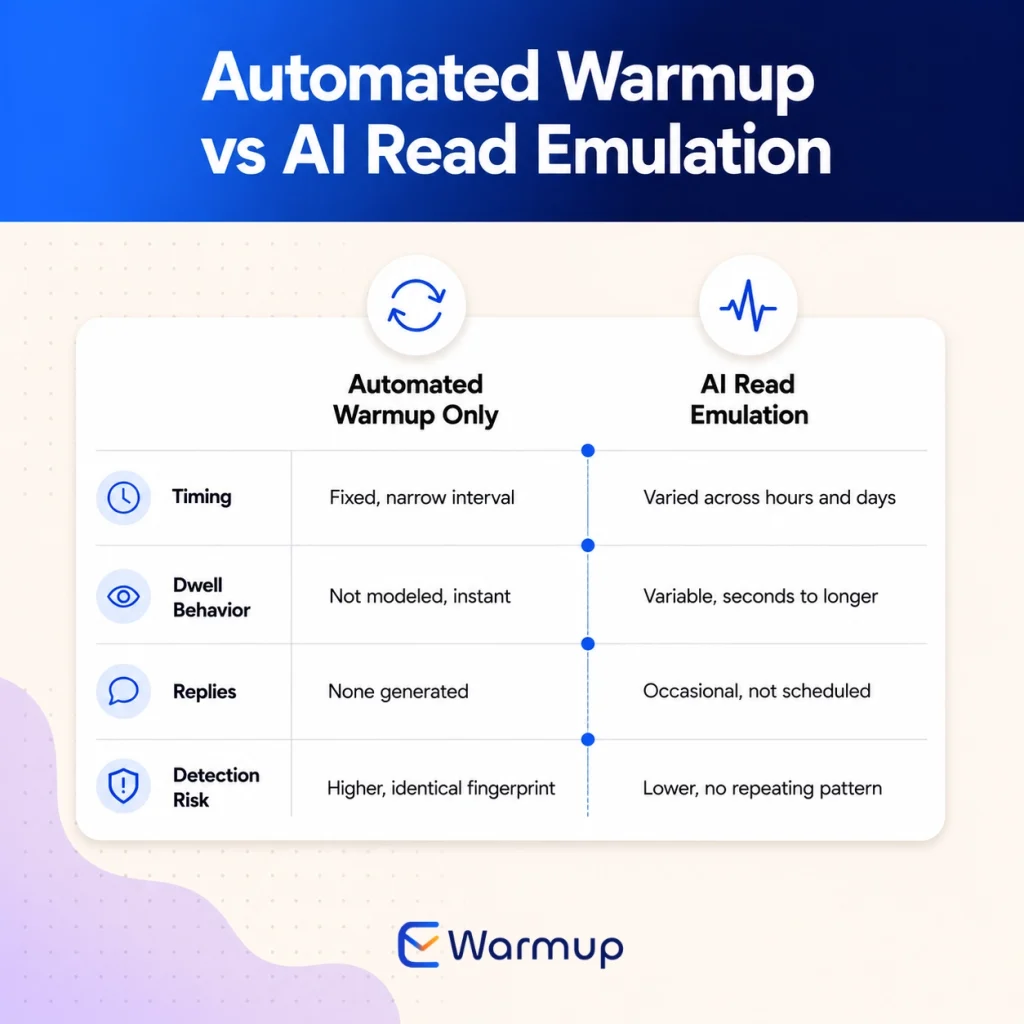
| Dimension | Automated Warmup Only | AI Read Emulation |
| Timing | Fixed, narrow interval | Varied across hours and days |
| Dwell behavior | Not modeled, treated as instant | Variable, seconds to longer |
| Replies | None generated | Occasional, not on a fixed schedule |
| Detection risk | Higher, identical fingerprint | Lower, no repeating pattern |
Why the Distinction Affects Results
Inbox providers have spent years building models to detect exactly this pattern: identical, scheduled engagement across a pool of accounts. It’s one of the clearest signals of automated warmup activity, and it’s not a subtle one to catch.
A domain running scheduled-only automation tends to show a specific fingerprint. Opens clustered in tight windows. Little to no dwell time variance. Almost no replies. Once an inbox provider’s model recognizes that fingerprint, the domain’s reputation gain from warmup activity starts flattening out, sometimes reversing entirely.
Litmus’s State of Email research has repeatedly pointed to engagement quality, not just volume, as a factor inbox providers weigh in sender reputation scoring. Volume without believable variance doesn’t move the needle the way many senders assume it does.
This is a pattern most deliverability practitioners have seen firsthand. A domain warms up fine for the first few weeks under a purely scheduled tool, then plateaus, or the placement rate starts sliding backward even though the sending volume hasn’t changed. The automation kept running. The trust signal it was producing stopped working.
Domains running engagement that actually varies- timing, dwell, occasional replies- don’t hit that same wall, because there’s no repeating fingerprint for a detection model to lock onto. The behavior looks different every day, because it’s not coming from a fixed script.
The practical result is that two domains can run the same sending volume for the exact same number of weeks and land in completely different places. One plateaus around week three because the pattern behind it got recognized. The other keeps climbing, because nothing about its engagement repeats in a way a detection model can key off of.
This is the part that’s easy to miss when comparing warmup tools by price or setup speed alone. Two tools can look identical on a pricing page and produce very different long-term outcomes, purely because of what’s happening inside the automation neither page describes in detail.
How to Tell Which One a Vendor Is Actually Selling
Vendor pages rarely say scheduled automation in plain language, because it doesn’t sound like much of a feature. Most describe it using the same AI-powered vocabulary as tools doing genuine engagement modeling, which makes the two nearly impossible to tell apart from the homepage alone.
A few direct questions tend to surface the answer fast.
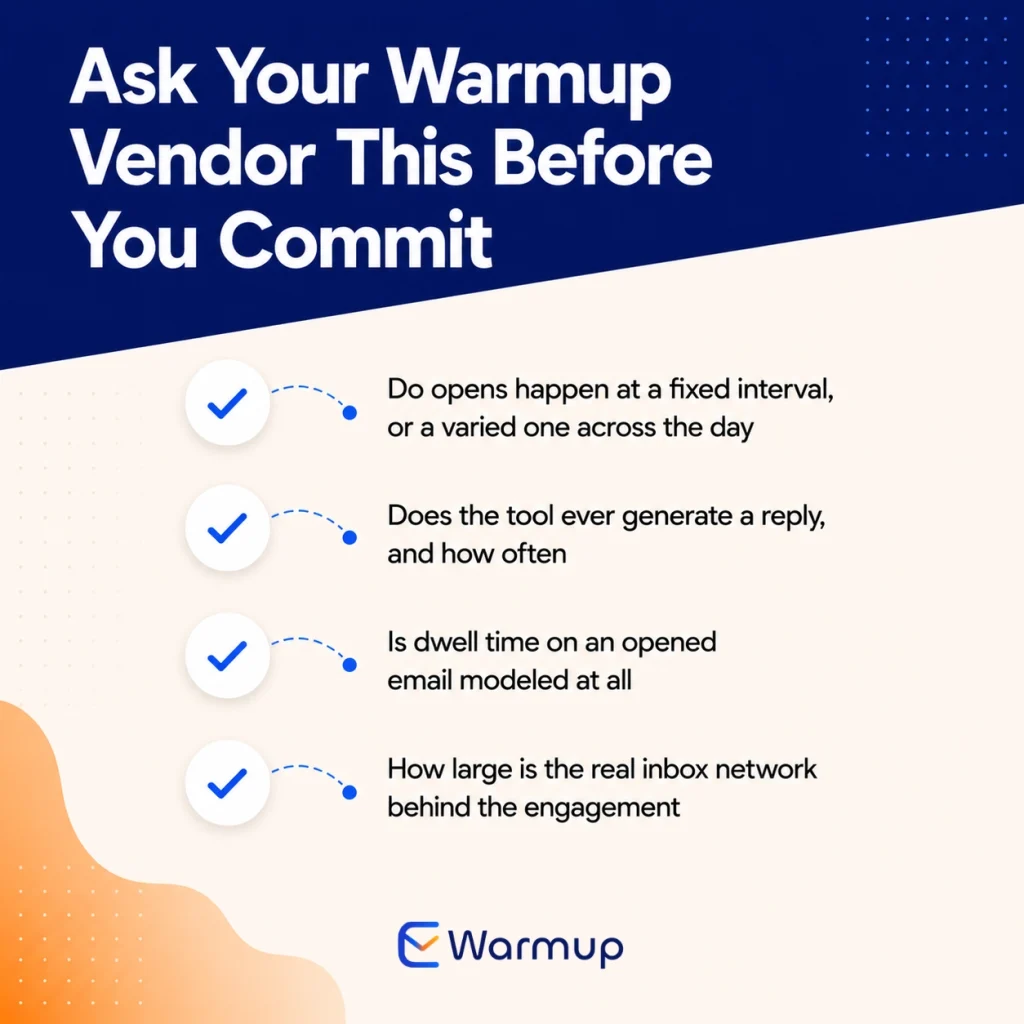
- Do opens happen at a fixed interval, or a varied one across the day
- Does the tool ever generate a reply, and how often
- Is dwell time on an opened email modeled at all, or treated as a single instant event
- How large is the real inbox network behind the engagement
A vendor running real engagement modeling can usually answer these specifics without hesitation, because the behavior is something they built deliberately. A vendor running scheduled automation under an AI label tends to answer in generalities, leaning on words like proprietary or advanced without describing an actual mechanism.
Where AI Read Emulation Fits
E-Warmup runs AI Read Emulation across a network of 40,000-plus real inboxes spanning 85,000-plus domains, not scheduled automation dressed up with a newer name. Every open is a physical action inside a real inbox, not an API call updating a status field.
That distinction matters because it’s the difference between a tool that removes your labor and a tool that actually builds something an inbox provider will trust. Automation alone gets your emails opened. It doesn’t get your domain believed.
The Free Forever plan includes AI Read Emulation with one mailbox and standard warmup volume, so you can compare the engagement pattern against whatever you’re running today, without a credit card or a trial clock attached to it.
Pairing that with a content check through the Email Template Spam Checker covers the layer AI Read Emulation doesn’t touch, since engagement quality and content quality are separate problems that both affect where your email lands.
Frequently Asked Questions
What is the actual difference between automated email warmup and AI Read Emulation?
Automated email warmup describes the delivery mechanism, sending and marking emails as read on a schedule without manual effort. AI Read Emulation describes what happens inside that automation, whether the engagement includes variable timing, dwell behavior, and occasional replies that resemble a real person rather than a repeating script.
Is every AI-powered warmup tool actually doing engagement emulation?
No. Many tools use AI-powered language to describe the same scheduled automation that’s existed for years, without any real variance in timing, dwell time, or reply behavior underneath it. The label alone doesn’t confirm the mechanism, which is why it’s worth asking a vendor directly before you commit.
Can inbox providers detect scheduled automation?
Yes. Inbox providers have built detection models specifically around this pattern: identical open timing across a pool of seeded inboxes with little to no variance. Once that fingerprint is recognized, the reputation benefit from continued warmup activity tends to flatten or reverse, even though the sending volume hasn’t changed.
Does automated warmup still help at all?
It can help in the early stages, since even scheduled opens signal some activity on a new domain. The limitation shows up over time, when inbox providers start recognizing the lack of variance and the trust gain plateaus, which is where emulated engagement continues producing results that pure automation can’t.
How do I know if my current tool is emulating engagement or just automating it?
Ask directly whether opens happen at a fixed interval or a varied one, whether the tool ever generates replies, and whether dwell time is modeled at all. A vendor running genuine emulation can answer specifics. A vendor running scheduled automation under a newer label tends to answer in generalities.
Does AI Read Emulation cost more than standard automated warmup?
E-Warmup’s Free Forever plan includes AI Read Emulation with one mailbox and standard warmup volume, with no credit card required and no trial period attached to it.
Why does variance in engagement matter more than the volume of emails sent?
Volume alone doesn’t build trust with an inbox provider if the pattern behind it looks scripted. Litmus’s State of Email research has pointed to engagement quality, not just send volume, as a factor in sender reputation scoring, which is why identical, high-volume automation can plateau while lower volume, varied engagement keeps building reputation.
The Bottom Line
Automated email warmup and AI Read Emulation aren’t marketing synonyms, even though vendor pages often treat them that way. One removes the manual labor of running warmup by hand. The other determines whether the resulting engagement looks like a person or a script to the inbox providers deciding where your email lands.
See the difference for yourself, free forever. No credit card required.
Related Reading
- AI Email Warmup: How AI Read Emulation Is Changing the Way Domains Build Trust — the pillar covering how physical read emulation works and why it changes reputation building.
- Best AI Tools for Avoiding Spam Filters in Cold Email Outreach — a breakdown of the three ways AI gets used across warmup tools, engagement simulation, content scoring, and send time optimization.
- Email Warmup Tool: The Complete Guide — the foundational pillar on choosing and setting up a warmup tool. (upcoming, March)
