Quick Answer
Click rate vs click through rate depends on the tool you use. Mailchimp treats them as one metric: unique clicks divided by delivered emails. Klaviyo and HubSpot label clicks divided by opens as CTR, a ratio most guides call click-to-open rate (CTOR).
- Click rate: unique clicks ÷ delivered emails × 100
- Click-through rate (CTR): the same formula in Mailchimp, clicks ÷ opens in Klaviyo and HubSpot
- Click-to-open rate (CTOR): unique clicks ÷ unique opens, the one ratio that isolates your content
- Denominator: delivered, not sent, because bounced emails can’t get clicked
- Reliability: Apple Mail Privacy Protection inflates opens and security scanners inflate clicks
- Low numbers: a low click rate can also mean the email never reached the inbox
Two people report on the same campaign. One quotes a 2.5% click rate from Mailchimp. The other quotes a 12.5% click-through rate from a Klaviyo or HubSpot report. Neither made a math error.
The gap comes from the number under the fraction. Open rate, click rate, and CTR are the email engagement metrics most reports lead with. This guide covers five mix-ups behind the click rate versus click-through rate confusion, starting with the formulas each platform uses.
Mix-Up 1: Click Rate Versus Click-Through Rate Means Different Things in Different Tools
Most guides say the two terms match. Mailchimp calls them technically the same metric, and FluentCRM says most email platforms use them interchangeably. Two large platforms disagree.
| Tool | Click rate | Click-through rate (CTR) | Source |
| Mailchimp | Unique clicks ÷ delivered | Same metric | Mailchimp |
| Klaviyo | Unique clicks ÷ received | Clicks ÷ opens | Klaviyo Help Center |
| HubSpot | Clicks ÷ delivered | Clicks ÷ opens (dashboard definition) | HubSpot Community |
The definitions drift inside single vendors too. Klaviyo’s blog describes CTR as clicks divided by total recipients, while its help center defines CTR as clicks divided by opens. HubSpot’s dashboard defines CTR by opens, and a HubSpot Community thread points out that a HubSpot blog post uses the delivered-based formula.
Check the denominator before you compare any two reports.
How to Calculate Email Click Rate (One Campaign, Three Numbers)
Take a campaign sent to 8,000 addresses. 160 bounce, leaving 7,840 delivered. From those, 1,568 people open the email and 196 click at least one link.
| Metric | Formula | Result |
| Open rate | 1,568 ÷ 7,840 | 20% |
| Click rate | 196 ÷ 7,840 | 2.5% |
| Click-to-open rate | 196 ÷ 1,568 | 12.5% |
| Click rate on sent (avoid) | 196 ÷ 8,000 | 2.45% |
The same 196 clickers produce 2.5% or 12.5%, depending on the denominator. That difference is the entire gap between click rate and CTR in Klaviyo and HubSpot.
Use delivered, not sent. Bounced emails can’t produce clicks, so counting them lowers your rate for a reason unrelated to your content, as a Klaviyo Community answer explains.
Count unique clicks. Klaviyo’s guidance says unique clicks measure true engagement better than total clicks, because repeat clicks on one link inflate the total.
Mix-Up 2: Delivered Doesn’t Mean Inbox
Both metrics divide by delivered emails, and delivered means the receiving server accepted the message. Attentive’s deliverability guide notes that delivery confirms a valid address and no rejection, but doesn’t show where the message landed.
Spam-folder mail counts as delivered. It rarely gets clicked.
Validity’s 2026 benchmark report puts the global average inbox placement rate at 87.2%, so about 1 in 8 sent emails misses the inbox.
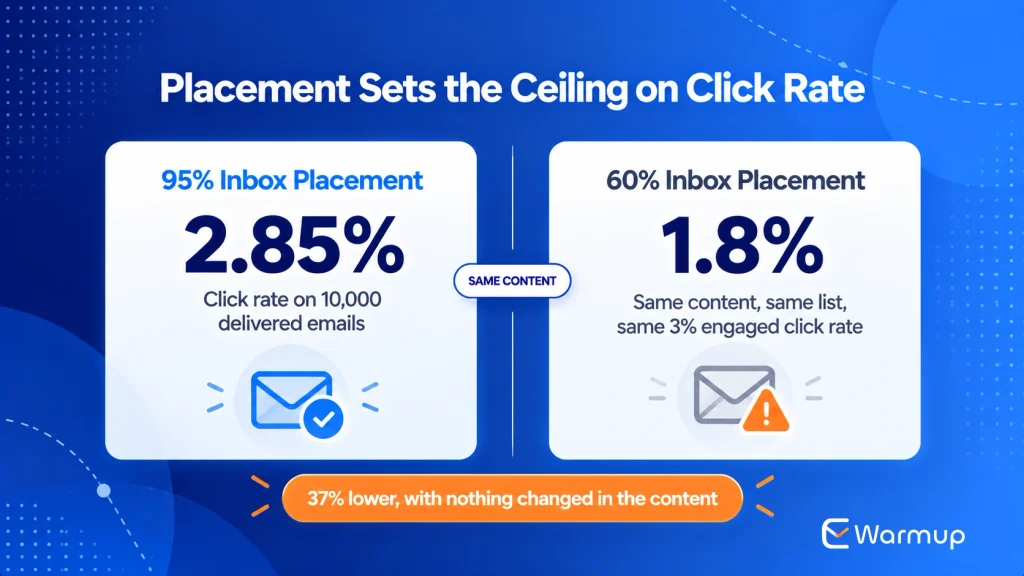
Here is what that does to a click rate. Say 10,000 emails are delivered and people who see yours in the inbox click at 3%.
- At 95% inbox placement: 285 clicks, a 2.85% click rate
- At 60% inbox placement: 180 clicks, a 1.8% click rate
These numbers are illustrative and assume spam-folder mail gets no clicks. The content didn’t change, yet the click rate fell 37%.
Rewriting subject lines won’t fix that. Placement is the constraint, and copy improvements downstream of a constraint add little. E-Warmup’s inbox placement tests, five a month on the Free Forever plan, show where a test send lands, so you can rule placement in or out before you touch copy.
If you send through Klaviyo or Mailchimp, you can’t connect a mailbox for standard warmup, because neither platform gives out SMTP access. Seed List Warmup covers that gap. You import real, engaged seed inboxes as an audience and send your campaign to them, and the seeds open, click, and pull mail out of spam. Each pack includes an inbox placement report, and one-time credits start at $6 for 50 seeds.
Related: Warmup dashboards show the same pattern, a healthy-looking score that measures the wrong thing.
Mix-Up 3: Email Open Rate vs Click Rate After Apple MPP
Open rate used to anchor the funnel. Klaviyo’s help center confirms that Apple Mail Privacy Protection prefetches the tracking pixel, so open rates run inflated.
CTOR divides by opens, so it inherits the error. Klaviyo’s blog calls click-to-open rate increasingly unreliable since iOS 15. A falling CTOR can mean the denominator grew with machine opens, and your content stayed the same.
For comparing campaigns, click rate holds up better. Its denominator is deliveries, which Apple’s prefetching doesn’t touch.
Mix-Up 4: Clicks Aren’t Always Human
Security software scans links before people read the message. M3AAWG’s 2020 report on nonhuman interactions (NHI) says a scan can register every link in every email sent to a domain as clicked in quick succession.
M3AAWG’s data put the impact under 10% for B2C senders. For B2B, it cites an overall impact of 20 to 80%, from data it collected but did not publish. Corporate inboxes run stricter filters, so B2B lists take the hit.
Mailchimp and Validity both warn that bot clicks distort A/B tests and reporting. A version sent mostly to strict corporate servers can win on clicks no human made.
M3AAWG also found a reputation link. Recipients with lower engagement draw more scans, and senders with highly engaged recipients see considerably less NHI. Its recommendation: build and maintain a positive reputation.
Three checks limit the damage:
- Plant a link no human would notice, such as a hyperlinked period, and check its click count. Analytics Playbook calls this a honeypot link.
- Use HTTPS on every link. M3AAWG found that emails mixing secure and non-secure tracking links draw disproportionate scanning.
- Handle engagement-based list cleaning with care. M3AAWG warns that NHI can keep dead addresses looking active.
Mix-Up 5: In Cold Email, Click Tracking Can Cost You the Inbox
Tracked links replace your URL with one that routes through the sending platform’s servers. Postmark’s documentation describes the redirect and names click.pstmrk.it as the tracking domain recipients see.
Hunter’s cold email guide notes that some spam filters may block emails containing tracking pixels or tracked links. Cold email has no prior relationship to offset that risk.
A safer default for a first touch: no tracked links, no pixel, and reply rate as the metric. If you need click data later, use HTTPS links on a tracking domain you control.
Turn tracking off and click rate disappears. Reply rate and a placement test still work.
Email Click Rate Benchmarks (and Why Cross-Tool Comparisons Fail)
Mailchimp treats a 2 to 5% click rate as successful, with technology companies above retail. Any average email click-through rate you find, and any CTR vs click rate comparison, needs its denominator checked first.
Klaviyo-style CTR runs higher by design. At a 20% open rate, a 2.4% click rate becomes a 12% CTR. Both describe the same performance.
If you run Seed List Warmup on Klaviyo or Mailchimp, the seed inboxes open and click your sends and count as engaged contacts. Keep them in a separate segment so they don’t inflate your click rate.
Low Email Click Rate: Content Problem or Placement Problem?
Read the pattern before you change anything.
| What you see | Likely cause | First check |
| Opens steady, clicks low, CTOR low | Weak CTA, offer, or audience match | A/B test one CTA and review the segment |
| Opens and clicks both dropped, content unchanged | Placement or reputation slip | Google Postmaster Tools and a placement test |
| Clicks arrive within seconds, replies and sales flat | Bot clicks | Honeypot link and your ESP’s bot filter |
| Click rate steady, CTOR sinking | MPP-inflated opens | Judge on click rate, not CTOR |
On Klaviyo or Mailchimp, a placement slip has no mailbox to warm. Seed List Warmup builds the engagement history through seed inboxes instead, and the placement report shows whether it worked.
How to Improve Email Click-Through Rate After Placement Checks Out
Send to engaged segments first. Klaviyo’s help center ties engaged segments to better deliverability and click rate. Then give each email one clear call to action.
Judge results on unique clicks, filtered for bots where your tool allows it.
If placement is the constraint, our guide to fixing sender reputation after landing in spam covers the recovery plan.
When Click Rate Is a Placement Problem: What E-Warmup’s Plans Add
The Free Forever plan gives you the diagnosis: five inbox placement tests and five DNS tests a month, plus sender reputation, bounce rate, and deliverability monitoring. Paid plans add the tools that fix and prevent the causes behind a low click rate.
- Blacklist monitoring and delisting (Basic and up): a blocklist listing can push mail to spam with no change to your content. Monitoring runs continuously, so a listing surfaces when it happens. It covers domain-level blocklists, not individual IP entries.
- AI Read Emulation (Growth and up): it opens emails with varied timing and dwell across 40,000+ real inboxes, instead of flagging a message as read the moment it arrives.
- Warmup with your own email copy (Basic and up): the warmup traffic carries your real links and signature, so your sending history matches the campaign you actually send.
- Deliverability Agent (every plan): it reads a mailbox’s sending and engagement data and explains problems in plain English, such as high bounce rates or failing SPF, DKIM, DMARC, and MX records, with steps to fix them.
| Feature | Free Forever | Basic ($49/mo) | Growth ($99/mo) | Premium ($189/mo) |
| Deliverability Agent | ✓ | ✓ | ✓ | ✓ |
| Reputation, bounce, and deliverability monitoring | ✓ | ✓ | ✓ | ✓ |
| Blacklist monitoring and delisting | ✗ | ✓ | ✓ | ✓ |
| Warmup with your own email copy | ✗ | ✓ | ✓ | ✓ |
| AI Read Emulation | ✗ | ✗ | ✓ | ✓ |
| Mailboxes / daily emails per mailbox | 1 / 10 | 5 / 150 | 20 / 300 | 40 / 500 |
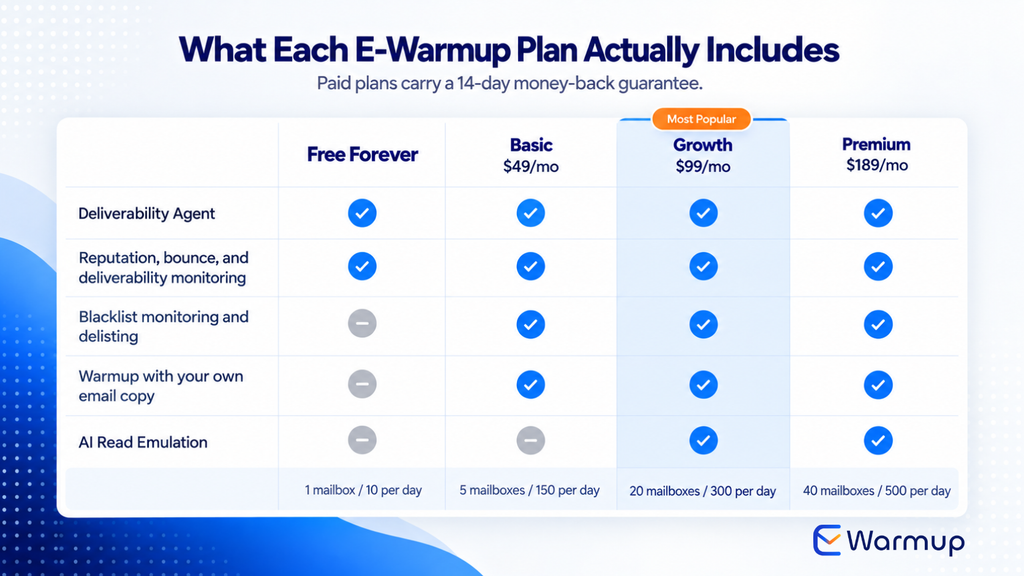
Paid plans carry a 14-day money-back guarantee, and the Free Forever plan stays free.
FAQs
What is the difference between click rate and click-through rate?
In most tools there isn’t one: both mean unique clicks ÷ delivered. Klaviyo and HubSpot use CTR for clicks ÷ opens, which other tools call click-to-open rate. Check the denominator in your report.
How do you calculate email click rate?
Divide unique clicks by delivered emails and multiply by 100. For example, 196 clicks on 7,840 delivered emails gives 2.5%.
What is a good email click rate?
Mailchimp treats 2 to 5% as successful, with variation by industry. Compare against your own history by segment, since tools count differently.
Why is my email click rate low?
Three causes come up most: weak content or targeting, inbox placement problems, and a denominator that includes spam-folder mail. Run a placement test before you rewrite copy.
What can I do if my Klaviyo or Mailchimp emails land in spam?
Those platforms don’t provide SMTP access, so mailbox-based warmup can’t connect to them. E-Warmup’s Seed List Warmup sends your campaign to real seed inboxes imported as an audience, with credits starting at $6 for 50 seeds. Run it, then check the placement report before you judge click rate again.
Do bot clicks affect email click-through rate?
Yes. Security scanners can register clicks before a person reads the email. M3AAWG puts the impact under 10% for B2C and cites 20 to 80% for B2B, from unpublished data.
Do clicks affect sender reputation?
Klaviyo and Mailchimp both say higher engagement improves deliverability. Mailbox providers haven’t published how much weight a click carries, so treat clicks as one signal among several.
How do I improve email click-through rate?
Confirm placement first. Then use one clear call to action, engaged segments, and HTTPS links, and judge results on unique clicks.
Should I turn off click tracking in cold email?
For a first touch, many senders skip tracked links because some filters block them. Track replies instead, and add click tracking on HTTPS links once a prospect engages.
Read the Denominator, Then Read the Inbox
Click rate versus click-through rate stops being confusing after two checks: the denominator in your tool, and whether the email reached a human inbox. The first takes a minute. The second takes a placement test.
E-Warmup’s Free Forever plan includes five inbox placement tests a month, no credit card required.