

Every inbox provider is quietly building a file on your domain. Sending history is most of what’s in it.
Gmail, Outlook, and Yahoo don’t judge a single email. They judge the pattern behind it, volume, engagement, complaints, and how consistent your authentication has stayed over time. Email domain reputation is the output of that judgment, not a setting you flip on.
What Counts as Sending History
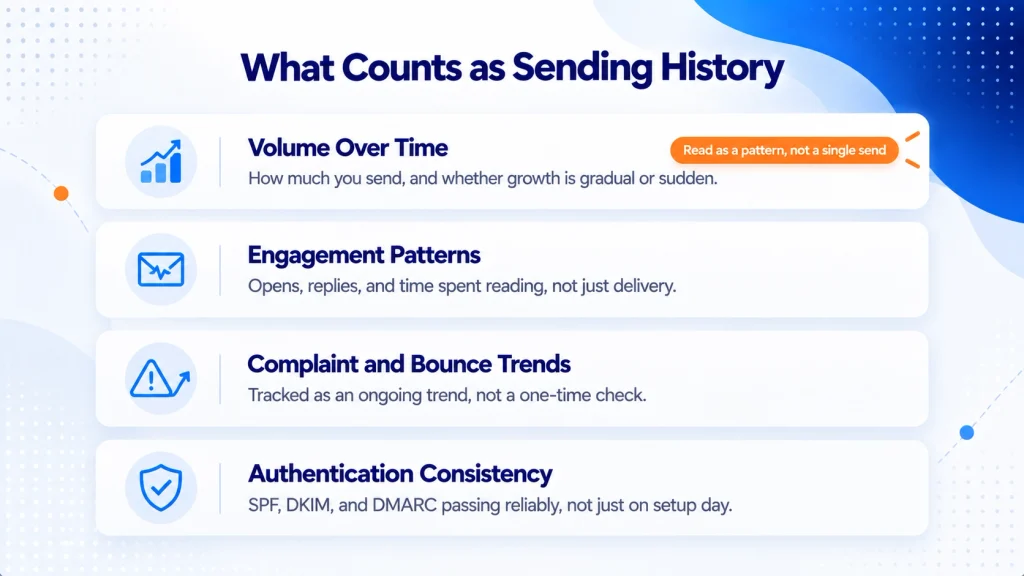
Volume over time sits at the center. Providers track how much mail you send, how that volume changes week to week, and whether growth looks gradual or sudden.
Engagement patterns matter just as much. Opens, replies, and how long recipients spend reading tell a provider whether real people want your mail. A domain with steady, varied engagement reads as legitimate. One with flat, identical patterns reads as automated.
Complaint and bounce trends feed the same file. Google’s bulk sender guidelines cap spam complaint rates at 0.3% for domains sending over 5,000 emails a day, and that threshold exists because providers track this number closely, not as a one-time check but as an ongoing trend.
Authentication consistency rounds it out. SPF, DKIM, and DMARC need to pass reliably, not just on setup day. A domain that occasionally fails authentication looks less trustworthy than one that passes every time, even if the failure rate is low.
Why History Matters More Than Any Single Send
Providers weigh patterns over weeks. One clean campaign doesn’t override a thin or erratic history, and one bad send doesn’t destroy a strong one either.
This is why a domain can run a perfect campaign and still land in Promotions. The campaign itself checked every box. The history behind it didn’t give Gmail enough reason to trust the domain sending it.
The reverse happens too. A domain with weeks of consistent, varied engagement can survive an occasional rough send without much damage, since providers are reading the trend, not reacting to a single data point.
Validity’s Sender Score benchmark research shows this pattern clearly: senders scoring below 60 see less than half their email reach the inbox, while senders scoring above 90 average placement rates near 92%. That gap comes from accumulated history, not from any one campaign.
What Builds a Strong History In Email Domain Reputation
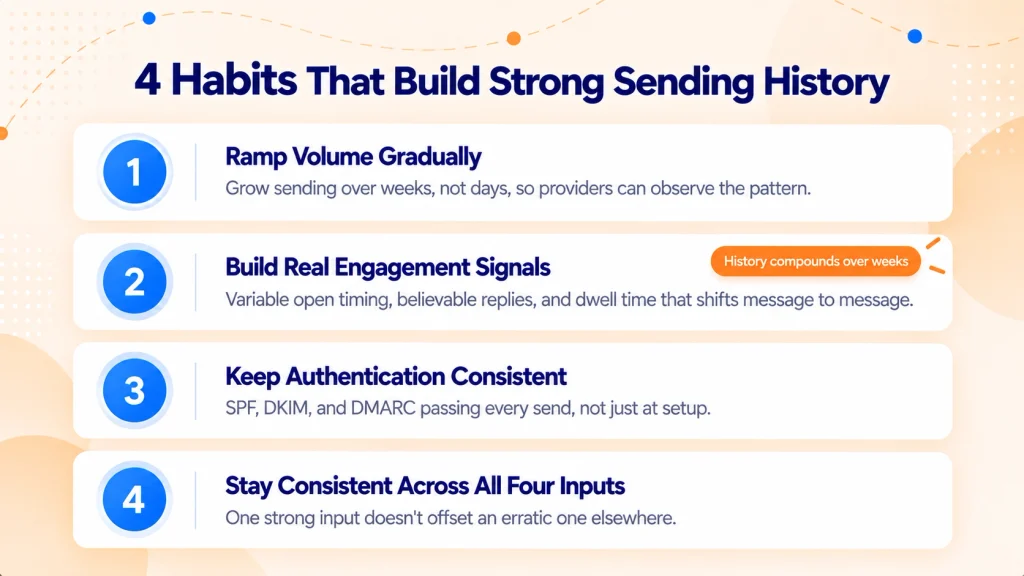
Gradual, consistent volume increases matter more than almost anything else on this list. A domain moving from 10 emails a day to 500 over a few days looks like a compromised account or a spam operation, regardless of how clean the content is.
A slower ramp, spread over weeks, gives inbox providers time to observe consistent behavior before deciding you’re trustworthy. This is the same logic behind any structured email warmup schedule, volume that grows in step with demonstrated trust rather than jumping ahead of it.
Real engagement signals build the rest. Variable open timing, a believable reply rate, and dwell time that shifts from message to message all read as human behavior. Email warmup tools built around this kind of variation, rather than a script that instantly flags every message as read, produce history that actually holds up once a real campaign launches.
Consistency across all four inputs, volume, engagement, complaints, and authentication, matters more than any one of them being perfect. A domain excelling at authentication but erratic on volume still reads as unpredictable.
What Damages It Fast
Sudden volume spikes top the list. A quiet domain that suddenly sends thousands of emails in a day triggers exactly the pattern filtering systems are built to catch, whether that spike came from legitimate growth or not.
Generic warmup patterns that don’t resemble real sending cause a slower, quieter version of the same problem. A domain that spends three weeks sending identical, templated content to a closed pool builds history for an email that looks nothing like the real campaign about to follow it. The mismatch shows up the moment the real send goes out.
Ignored blacklist hits do lasting damage precisely because they’re easy to miss. A domain can land on a blacklist mid-week and keep sending, unaware, for days before anyone notices the placement drop that followed. Continuous monitoring catches this early. A one-time check, run once at setup and never again, doesn’t.
Erratic authentication compounds all of it. A domain that passes SPF and DKIM most of the time but fails intermittently gives providers a reason to treat every message with more scrutiny, even the ones that pass cleanly.
Building Real History With E-Warmup
E-Warmup builds sending history through varied, realistic engagement across 40,000+ real inboxes, not a fixed seed pattern repeated on a loop. Open timing spreads across a realistic window. Reply rates stay believable rather than uniform. Dwell time shifts from message to message the way it would for an actual recipient reading actual content.
Volume ramps gradually by design, rather than jumping to a fixed target on a calendar countdown. Blacklist monitoring runs continuously, so a listing surfaces the day it happens rather than whenever someone thinks to check.
That combination, gradual volume, genuine engagement variation, and continuous monitoring, builds exactly the four-part history inbox providers are actually reading. A domain sending consistently through this kind of warmup earns trust that holds up once cold email deliverability actually gets tested by a real campaign.
Sending History FAQ
How long does it take to build strong sending history?
Most domains need two to four weeks of consistent, varied sending before providers extend meaningful trust. A domain recovering from a prior reputation hit typically needs longer, since recent negative history weighs more heavily than an equivalent stretch of no history at all.
Does one bad campaign ruin sending history built over weeks?
Rarely on its own. Providers weigh trends, not single events. A domain with weeks of consistent, varied engagement can usually absorb one rough send without major damage, though a pattern of repeated problems will erode that trust over time.
What’s the difference between sending history and sender reputation?
Sending history is the raw pattern of behavior, volume, engagement, complaints, authentication, that a domain accumulates over time. Sender reputation is the trust score inbox providers derive from reading that history. History is the input. Reputation is the output.
Can a new domain build sending history faster by sending more volume?
No. Volume without gradual pacing looks like exactly the kind of spike filtering systems flag. A slower, consistent ramp builds trust faster than pushing volume ahead of what the domain’s history has earned.
Why does generic warmup content damage sending history even with clean delivery?
Because the history being built doesn’t match what the real campaign will actually look like. A domain warmed up on placeholder text with no links or signature, then launched with a campaign full of both, shows providers a sudden structural shift, which reads as suspicious even when delivery itself stays clean.
Does authentication need to pass every single time, or is occasional failure acceptable?
Occasional failures do measurable damage, since inconsistency itself is a signal providers weigh. Aim for authentication passing reliably every send, not just on initial setup, and treat any recurring failure as something to fix immediately rather than monitor passively.
Start Building Real Sending History
Inbox providers aren’t judging your best campaign. They’re judging the pattern behind every send that came before it.
Start building real sending history, free.

Related Reading
- How to Fix Sender Reputation After Landing in Spam — the recovery process for a domain whose history has already taken a hit.
- Email Reputation Checker Says 100%? Why That Doesn’t Mean Your Campaigns Reach the Inbox — why a clean score doesn’t always reflect real sending history.
