Most outreach platforms bundle a warmup feature into the price. It runs in the background, shows a health number that looks fine, and most people never question what it’s actually doing. You turn it on once, during setup, and then forget about it. Weeks later, your first real campaign goes out, and something feels off.
Open rates are lower than expected. Replies barely trickle in. The health score in your dashboard still says everything’s fine.
Here’s the uncomfortable part. That number was never designed to tell you what you think it’s telling you. Your outreach tool’s email warmup service isn’t actually warming anything up.
Once you understand what it’s actually measuring, a lot of “cold email doesn’t work” frustration starts to make a lot more sense.
The Feature Exists, The Job Doesn’t Get Done
Built-in warmup in tools like Instantly, Smartlead, and Woodpecker works roughly the same way across all three. Your account joins a shared pool of other users’ accounts running warmup at the same time.
Accounts in that pool send each other emails, open them, sometimes reply, and occasionally pull a message out of spam. Instantly’s own help documentation describes this directly: your account sends warmup emails to other users in the pool, and those users automatically open and reply.
That’s the mechanism. It’s not fake, and it’s not nothing. Instantly’s help center even puts a number on it: an account should hit a warmup health score above 90% before it’s considered ready for a real campaign.
But there’s a real difference between having a warmup toggle switched on and warmup that actually changes anything about how your specific domain gets treated once real prospects, not other warmup accounts, start receiving your mail.
What Generic Warmup Actually Optimizes For
Here’s the part that’s easy to miss when you’re just glancing at a dashboard. Built-in warmup features are largely designed to keep an account out of immediate trouble, not to build durable domain reputation over time.
The metrics they surface reflect that narrow scope. You’ll see bounce rate, account balance, and a health score that moves in one general direction as long as warmup emails keep getting opened and replied to inside the pool.
That’s a real signal, but it’s a narrow one. It tells you the pool likes your account.
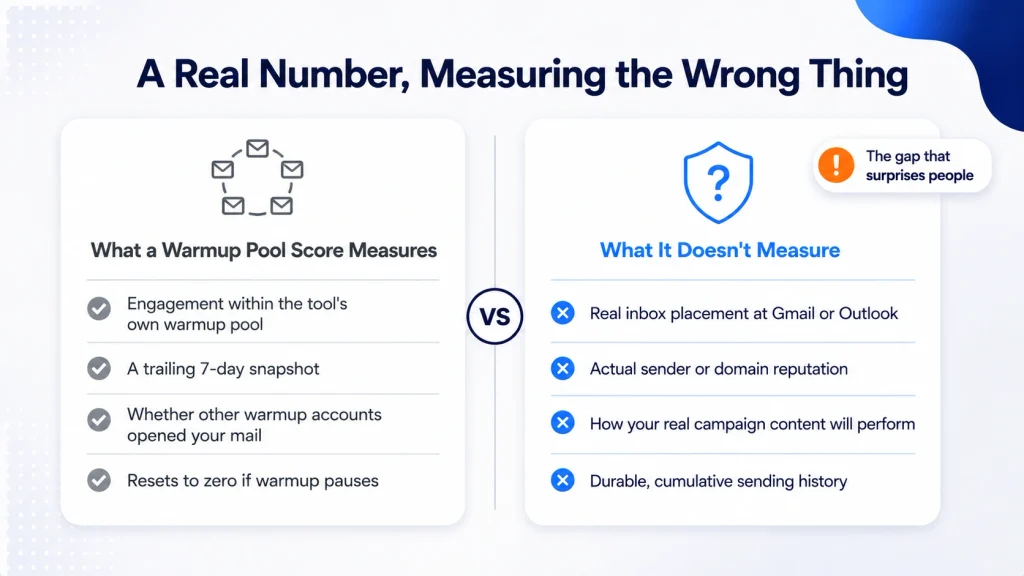
It doesn’t tell you much about your actual email domain reputation with Gmail, Outlook, or Yahoo specifically, since none of those providers see the warmup pool the same way they’ll see your real campaign traffic.
A flat or slow-moving health score is one of the clearest warning signs here. If the number hasn’t meaningfully changed in weeks, it’s likely reflecting pool activity, not real inbox provider trust.
What the Health Score Actually Measures, and What It Doesn’t
This is worth getting specific about, because it’s the piece most senders never actually check. Instantly’s own help documentation spells out exactly how their health score is calculated.
It’s the percentage of warmup emails that landed in the inbox versus spam, measured only within the warmup pool, only over the trailing 7 days. Their own example puts it plainly: send 70 warmup emails in a week, 3 land in spam, and the score comes out around 95.7%.
That’s a real formula. It’s just not measuring what most people assume it’s measuring.
It says nothing about how your domain performs at Gmail’s actual filtering layer for a real prospect who’s never seen your domain before, and it resets to zero if warmup goes quiet for a week, regardless of how solid your sending history is otherwise.
An independent 2026 review of Instantly’s warmup feature documented exactly the gap this creates in practice. Accounts showing a healthy internal warmup score have been observed landing in spam during live campaigns.
The review notes this gap between Instantly’s internal score and actual inbox placement is documented across multiple independent tests and user reports, not an isolated complaint.
None of this makes the score fake. It’s a real, calculated number, and Instantly is transparent in its own documentation about what it’s measuring. The problem is what happens when a sender treats a warmup-pool engagement score as if it were a promise about real inbox placement, sender reputation, or domain reputation with the providers that actually decide where a campaign lands.
Most bundled warmup features across the outreach tool category share this same structural limitation, because the underlying mechanism, a shared pool of tool-native accounts engaging with each other, produces the same kind of score by design. It’s not a formula problem specific to one vendor.
It’s what happens when warmup activity and real deliverability get measured with the same number.
Why Bounce Rate and Domain Reputation Numbers Are Often Missing Entirely
Bounce rate and domain reputation deserve a closer look too, since they’re the two metrics most senders assume they’re seeing when they aren’t.
Bounce rate, as most bundled warmup dashboards report it, usually reflects bounces within the warmup pool itself. Pool accounts are maintained specifically to receive warmup mail, so bounces there are rare almost by design.
That produces a reassuringly low number that has little bearing on how your real prospect list will behave.
Domain reputation is an even bigger gap. A genuine domain reputation check pulls from sources like blacklist databases, authentication status across SPF, DKIM, and DMARC, and how major providers like Gmail and Microsoft classify your sending domain specifically.
Most built-in warmup features don’t surface any of this directly, and when they do, it’s usually a pass or fail toggle rather than a real, explained score.
Sender reputation follows the same pattern. It’s a genuinely useful signal when it’s built from real provider-level data. It’s much less useful when it’s inferred entirely from how a closed pool of warmup accounts happened to behave that week.
None of this means these platforms are lying to you. The numbers they show are usually accurate descriptions of what happened inside their own systems.
The issue is scope, not honesty, and scope is exactly what gets lost when a dashboard shows a single clean percentage with no explanation of what it does and doesn’t include.
This is also where cold email deliverability specifically diverges from general email marketing metrics. A newsletter platform’s bounce rate and engagement numbers are drawn from real subscribers who opted in.
A cold outreach tool’s warmup numbers are drawn from a pool of other users running the same feature, which is a fundamentally different data source, even when the dashboard styling makes both look equally authoritative.
The practical takeaway is simple. Before trusting any number in a warmup or deliverability dashboard, ask what population it was measured against.
A score built from real recipient behavior across actual inbox providers tells you something meaningful. A score built from a closed pool of accounts running the same warmup feature tells you something much narrower, no matter how confident the percentage looks.
What Real Warmup Actually Requires
Fixing this starts with one structural change: sending your own real email copy during warmup, not generic placeholder text the tool generated for you. This is sometimes called bring your own copy, and it’s the single biggest gap between a warmup toggle and warmup that actually works.
If your real campaign uses a signature, includes a link, and follows a specific tone, your warmup emails need to reflect that from day one. Otherwise you’re building sending history for an email that doesn’t resemble the one you’re actually going to send.
Matching the correct audience type matters just as much. B2B and B2C sending patterns look different to inbox providers, in volume, in typical reply behavior, and in what a normal recipient relationship looks like.
Warmup that doesn’t account for which one you’re building toward is optimizing for the wrong pattern.
Continuous blacklist monitoring, not a one-time check, is the next piece. A domain can land on a blacklist mid-campaign with no warning from a tool that only checks status when you manually ask it to. Automatic detection and removal close that gap before it costs you a launch.
Genuine engagement behavior rounds it out. Identical mark-as-read patterns across every warmup email are exactly the kind of synthetic signal modern filtering has gotten better at catching.
Variable open timing, dwell time, and a believable rate of replies matter more than raw volume, and more than a score that only counts activity inside a closed pool.
Why the Campaign Fails Right After Warmup Looked Fine
This is the pattern that trips up the most senders. Warmup runs for two or three weeks. The dashboard looks healthy, sometimes north of 90%.
Then the actual campaign goes out, and performance doesn’t match what warmup seemed to promise.
The reason is usually structural, not random bad luck. Warmup emails sent through most built-in tools are AI-generated text, built specifically for the pool. Smartlead’s own documentation is explicit about this: warmup emails have nothing to do with your actual email campaigns. They’re a separate stream entirely.
Then the real campaign launches with a completely different structure. Links appear. A signature block shows up. The formatting shifts from plain conversational text to something closer to a marketing template.
Inbox providers, which evaluate content patterns alongside sending history, catch that mismatch fast. Your sending history up to that point was built on one kind of email.
Your real campaign is a different kind of email entirely, sent from the same domain, and providers treat that shift with more suspicion than a domain with zero history at all.
Why B2B and B2C Warmup Need Different Baselines
The audience-matching gap deserves a concrete example, since it’s easy to nod along with in principle and still miss in practice.
A B2B sender targeting operations managers at mid-size companies typically sends lower volume, expects slower reply cycles, and benefits from warmup traffic that mirrors that pace, occasional replies spread over days, not hours.
A B2C sender running a promotional campaign to a consumer list behaves differently, often at higher volume, with different expected engagement timing.
A warmup feature that runs the exact same pool-based pattern regardless of which type of sender is using it is optimizing for a generic middle ground that doesn’t actually match either use case well. The sending history it builds doesn’t resemble what either kind of real campaign will look like once it launches.
This is one of the quieter reasons a healthy-looking warmup score can still precede a rough campaign launch. The engagement pattern being built during warmup was never calibrated to the audience the real campaign was actually going to reach.

Why Does the Score Reset or Drop for No Clear Reason?
One more detail worth knowing, since it catches people off guard. Instantly’s own documentation notes that its warmup health score only reflects the most recent 7-day period, and resets to zero entirely if no warmup emails were sent during that window.
That’s a reasonable design choice for the narrow thing the score is meant to track, but it means the number can swing dramatically based on short-term activity rather than reflecting a stable, cumulative picture of domain trust.
A sender who pauses warmup for a week ahead of a campaign, assuming their reputation is banked, can come back to a score that’s dropped to zero, even though nothing about their actual sending history changed.
This is a good illustration of the broader point. The number isn’t measuring domain reputation as a durable asset. It’s measuring recent pool activity, and recent pool activity is a much more volatile, much narrower thing.
Real reputation tracking should behave differently. It should hold steady during a quiet week and only move meaningfully when actual sending behavior or provider-level signals change, since that’s what a durable trust asset is supposed to look like.
The Pattern Behind Most “Outreach Doesn’t Work” Complaints
There’s a common thread in why people quit cold email after one bad campaign. They ran a warm-up, the dashboard looked fine, sometimes showing a score in the 90s, the campaign underperformed anyway.
The conclusion they land on is that cold email itself doesn’t work.
That’s rarely the actual problem. More often, the domain never built the kind of sending history and reputation that real warmup requires. The warmup-pool score said one thing.
Gmail and Outlook‘s actual filtering decisions said another. The channel gets blamed. The tool that never warmed the domain up correctly, and never told the sender that, doesn’t.
This matters because it’s an expensive misdiagnosis. A team that concludes cold email doesn’t work moves on to a different channel, without ever fixing the underlying deliverability gap that caused the failure in the first place.
They also never learn that the number they trusted wasn’t measuring what they thought it was.
The pattern repeats often enough that it’s worth naming directly, a flat or artificially healthy health score, a generic warmup stream, and a real campaign that looks nothing like the warmup traffic that preceded it.
That combination predicts a rough launch more reliably than almost anything else, and it’s precisely why so many teams evaluating outreach tool alternatives eventually go looking for something built specifically around sender reputation, not campaign management with a warmup feature attached.
Warmup Feature Checklist
Before trusting any warmup feature, built into your outreach platform or standalone, run it through a few direct questions.
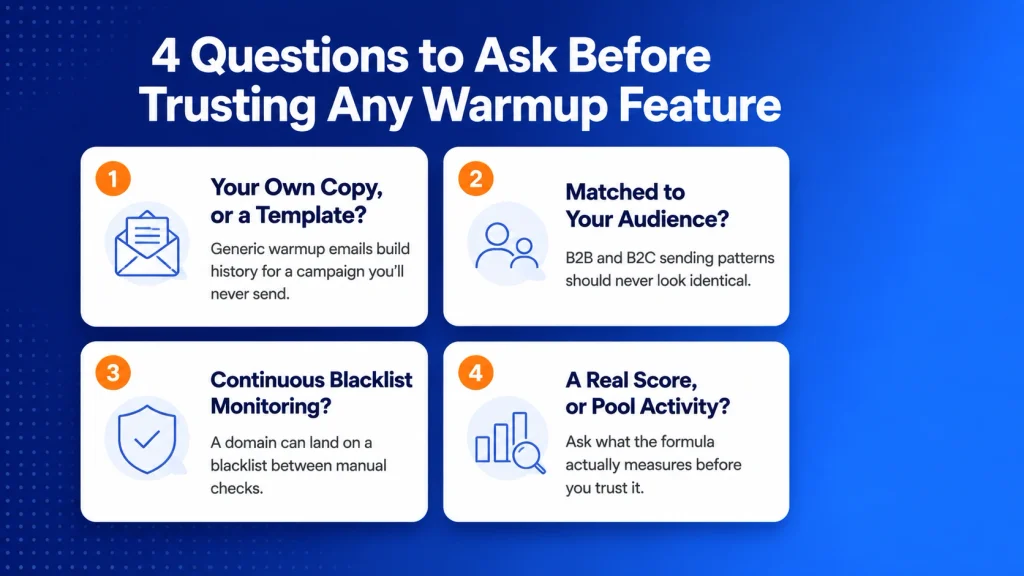
Does it use your own copy, or a generic template? If warmup emails don’t resemble what you’ll actually send, the sending history being built doesn’t match your real campaign.
Does it target your actual audience type? B2B and B2C warmup should behave differently. A tool that treats every account the same regardless of audience is missing a real variable.
Does it monitor blacklists continuously, or only on request? A domain that lands on a blacklist between manual checks can lose a campaign before anyone notices.
Does it show a real reputation score, or a number measuring only pool engagement? Ask specifically what the formula behind the number is. If the answer is “activity within our own warmup network,” that’s a different thing from actual inbox placement at Gmail, Outlook, or Yahoo.
Warmup Feature FAQ
Is a built-in warmup feature enough on its own?
Not usually, if it’s running generic templated emails to a shared pool without matching your real campaign’s audience or copy. It can help avoid immediate spam flags, but it doesn’t build the kind of durable domain reputation a real campaign depends on.
The health score it shows you typically doesn’t reflect actual inbox placement with real providers.
Why does my health score say 95% but my campaign still landed in spam?
Because the health score most bundled warmup features show is measuring engagement within their own warmup pool, not your standing with Gmail or Outlook specifically.
Independent reviews of major outreach platforms have documented exactly this gap, accounts with healthy internal scores still landing in spam once a real campaign goes out to real recipients.
How long does real warmup take?
Most domains need at least two to four weeks of consistent, varied warmup before reputation stabilizes, and longer for domains recovering from a prior reputation hit.
The timeline depends on starting reputation, sending volume, and whether the warmup traffic actually resembles the real campaign that follows it.
Can a domain recover after a bad first campaign?
Yes, though it takes longer than starting fresh. Reputation systems weight recent behavior heavily, so a domain that had a rough launch needs a more deliberate, extended warmup period afterward.
Just returning to the same generic warmup toggle that missed the problem the first time won’t fix it.
What’s the difference between an email warmup service and a built-in warmup feature?
A dedicated email warmup service is typically built around continuous reputation building as its core function, with features like audience-specific targeting, blacklist monitoring, and real engagement variation. A built-in feature bundled into an outreach platform is usually a lighter add-on designed to keep an account functional, not to build reputation as its primary job, and its reporting reflects that narrower purpose.
Does sending history matter more than the warmup tool itself?
Sending history is the actual asset being built. The tool is just the mechanism. A domain with a short but consistent, well-matched sending history is in better shape than one with months of generic warmup traffic that never resembled its real campaigns, no matter how good the dashboard number looked along the way.
The Bottom Line
A warmup toggle and real warmup aren’t the same thing, even when they’re labeled identically inside your outreach platform. The mechanism behind the label, and the formula behind the number it shows you, are what actually determine whether your domain earns trust before a campaign launches.
Own copy warmup, correct audience targeting, continuous blacklist monitoring, and genuine engagement variation are the pieces that make the difference. Most built-in features are missing at least two of them.
Most of their health scores were never built to measure your actual standing with the inbox providers who decide where your emails land.
E-Warmup runs across a network of 40,000+ real inboxes and 85,000+ domains, using your own copy, matched to your actual audience type, with automatic blacklist removal and a genuine multi-signal health score built from real deliverability, sender reputation, and domain reputation data.
That’s the standard worth holding any warmup dashboard to, whether it’s bundled into an outreach platform or built as a dedicated tool. See what real warmup actually requires, free forever, no card required.
Related Reading

Instantly Alternatives: What Instantly, Smartlead, and Woodpecker’s Built-In Warmup Actually Does
Sending History 101: How Inbox Providers Judge Your Email Domain Reputation
Click Rate vs Click Through Rate: Why the Same Campaign Shows Two Different Numbers
How to Fix Sender Reputation After Landing in Spam (30-Day Plan)
Email Reputation Checker Says 100%? Why That Doesn’t Mean Your Campaigns Reach the Inbox