

AI gets mentioned in every warmup tool’s marketing now. Every product page has the word somewhere, usually near the top, usually in bold.
But the actual mechanism behind that word varies a lot depending on which tool you’re looking at, and vendors rarely explain the difference. Finding the best ai for avoiding spam filters in cold email outreach means knowing which mechanism you actually need before you evaluate a single vendor.
Some tools use AI to simulate how a real person engages with an inbox. Others use it to predict whether your subject line will get flagged before you even hit send. A few use it to figure out the best time to send a message in the first place. These are three different jobs, and conflating them is how buyers end up with a tool that solves a problem they don’t have.
This post breaks down what AI actually does across these different use cases, with real examples of tools built for each layer, and gives you a framework for evaluating any tool that claims to help with cold email deliverability before you commit budget to it.
Finding the Best AI for Avoiding Spam Filters in Cold Email Outreach Starts With the Mechanism
There are three distinct mechanisms hiding under the same “AI-powered” label, and they solve genuinely different parts of the deliverability problem. None of them compete with each other directly, since each one is built to solve a different layer of the same outreach stack.
Engagement simulation. This is the layer behind AI email warmup. A network of real inboxes receives your emails, and AI models the way those inboxes interact with the message, when it gets opened, how long it’s viewed, whether it gets a reply. The goal is building sender reputation over time by making a domain’s sending history look like it belongs to a trusted, established sender. E-Warmup operates in this category, running AI Read Emulation across a network of 40,000+ real inboxes.
Content scoring. This is a completely different job. Tools like Mail-tester analyze your subject line and body copy before you send, running it against SpamAssassin-based scoring and authentication checks to flag trigger words, formatting issues, and blacklist status. E-Warmup’s own free Email Spam Checker does the same job, scoring your content before it goes out and telling you exactly what’s driving the score. This addresses cold email deliverability at the message level, not the domain level, and it’s a useful companion check regardless of which warmup tool you’re running.
Send-time optimization. A newer application, this uses AI to predict when a specific recipient is most likely to open an email. Seventh Sense is a well-known example, built specifically for HubSpot and Marketo users, using historical engagement data to time individual sends rather than blasting a list all at once. This layer improves the odds an email gets seen once it lands, but it doesn’t touch reputation or content risk at all.
None of these three replace the others, and none of them are actually competing for the same job. A content scoring tool won’t fix a domain with no sending history. A send-time tool won’t catch a subject line packed with spam trigger phrases. And a warmup tool won’t tell you if your copy itself is the problem. The role AI plays in enhancing email deliverability only works when you understand which layer you’re actually buying, and most serious senders end up running one tool from each category rather than expecting a single tool to cover all three.
Free Tools Worth Running Before You Spend on Anything
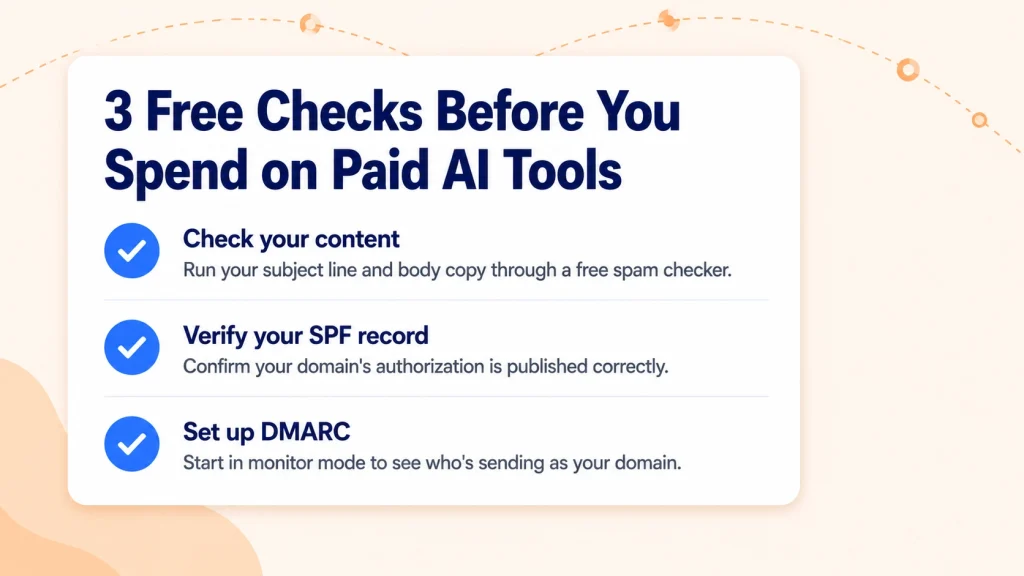
Before evaluating paid AI tools in any of these three categories, it’s worth running your setup through a few free checks first. These won’t fix reputation or engagement issues, but they catch the kind of basic gaps that make every other layer perform worse.
Check your content with a spam checker. Paste your subject line and body into a free tool like Mail-tester or E-Warmup’s Email Template Spam Checker before sending a cold campaign. Both score your content against SpamAssassin-style rules and flag exactly what’s pulling your score down.
Verify your SPF record. A missing or duplicate SPF record breaks authentication regardless of how good your content or reputation is. E-Warmup’s free SPF Record Generator checks your domain’s existing DNS setup and outputs a ready-to-publish record in under a minute.
Set up DMARC, even in monitor mode. Gmail and Yahoo now require DMARC for bulk senders, and it’s the layer that tells providers what to do when SPF or DKIM checks fail. E-Warmup’s free DMARC Record Generator walks through policy selection and reporting setup without needing DNS expertise.
None of these three free tools touch sender reputation. They fix the parts of your setup that are either broken or not broken, with a clear yes or no answer. Reputation is the part that takes ongoing work, which is where warmup comes in, and it’s usually the deciding factor in which vendor ends up being the best ai for avoiding spam filters in cold email outreach for a given sender.
What to Evaluate Before Trusting the Claim
Once you know which mechanism a tool is actually offering, the next step is figuring out whether the implementation is real or just a label. Here’s what to ask.
What data is the model trained or built on? Engagement simulation tools should be able to describe how they generate variation in open timing and reply behavior. Content scoring tools should be able to point to a recognized scoring standard, like SpamAssassin’s rule set, rather than a vague internal score with no reference point.
Is the claim testable? A vendor that says their AI improves deliverability should be comfortable with you testing that claim directly. Ask for a trial period long enough to see actual placement data, not just a demo of the interface.
Does the mechanism match the problem you actually have? If your domain is new and has no sending history, content scoring alone won’t fix your placement rate. If your content is triggering spam filters on an established domain, warmup alone won’t fix that either. Match the tool to the specific failure point.
How is success measured and reported? Look for tools that show you concrete numbers, like Google’s Postmaster Tools does for spam rate and domain reputation, rather than a vague internal health score with no way to verify it independently.
Is the tool compliant with baseline email regulations? Any legitimate outreach tool should be built with awareness of requirements like the CAN-SPAM Act, including accurate header information and a working opt-out mechanism. A tool that ignores this is a bigger risk than one with a mediocre AI model.
A few more signs a claim doesn’t hold up under scrutiny:
- The vendor can’t explain their mechanism beyond “our proprietary AI”
- Every customer testimonial mentions the interface, never the actual placement results
- There’s no way to see engagement data broken down by inbox or by day
- The tool bundles engagement simulation and content scoring under one vague feature name with no way to isolate which part is doing the work
Common AI Claims Worth Double-Checking
A few specific phrases show up across vendor pages so often they’re worth calling out directly, since they sound precise but often aren’t.
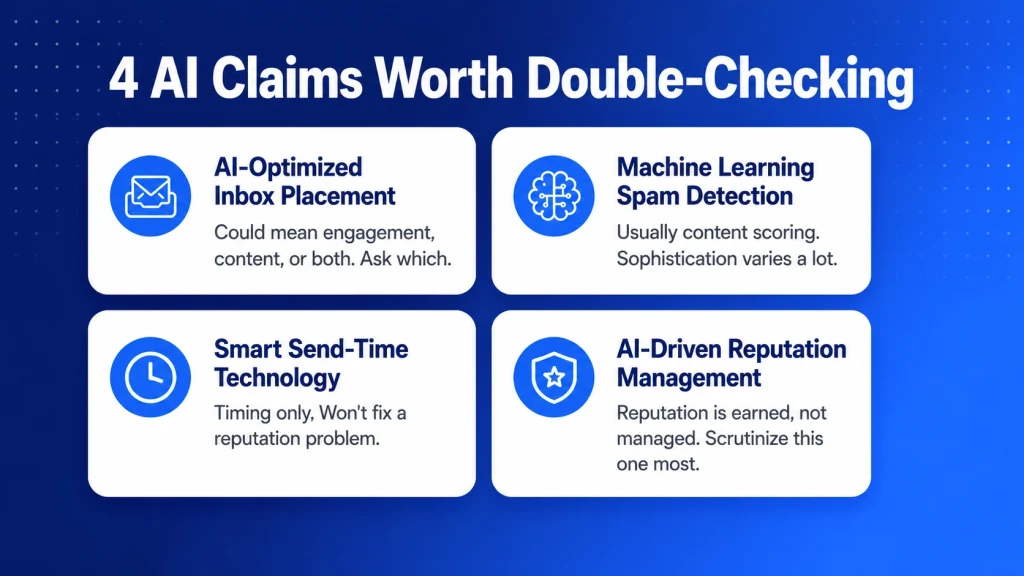
“AI-optimized inbox placement.” This phrase alone doesn’t tell you whether the optimization is happening at the engagement layer, the content layer, or both. Ask which one, and ask for evidence.
“Machine learning powered spam detection.” This usually refers to content scoring, similar in spirit to how SpamAssassin’s Bayesian filtering works, but the sophistication varies enormously between vendors. A model trained on a small, outdated dataset behaves very differently from one updated against current filter behavior.
“Smart send-time technology.” This is almost always the send-time optimization layer, the same category Seventh Sense operates in. It’s a genuinely useful feature, but it won’t move the needle if your domain has a reputation or authentication problem underneath it.
“AI-driven reputation management.” This one deserves the most scrutiny. Reputation isn’t something AI manages directly; providers assign it based on observed behavior over time. What AI can do is generate the varied engagement patterns that influence how that reputation builds. If a vendor can’t explain that distinction, the claim is likely more marketing than mechanism.
Why This Distinction Matters More for Cold Email Specifically
Cold email carries more deliverability risk than most other categories of outreach, which is exactly why the ai role in enhancing email deliverability gets discussed so much in this specific context, and why the search for the best ai for avoiding spam filters in cold email outreach tends to focus on cold campaigns specifically rather than email marketing broadly.
Recipients haven’t opted in the way they have with a newsletter list. There’s no prior relationship for inbox providers to weigh in the sender’s favor. That means both layers, reputation and content, matter more here than almost anywhere else in email marketing.
A cold email campaign sent from a domain with strong sender reputation but sloppy, trigger-word-heavy copy will still underperform. So will a campaign with pristine copy sent from a domain with zero sending history. Cold outreach is one of the few use cases where skipping either layer shows up in your numbers almost immediately.
This is part of why evaluating tools by mechanism, not by marketing language, matters so much for teams running cold outreach specifically. The margin for error is thinner, and a mismatched tool wastes weeks of campaign time before the gap becomes obvious.
How These Mechanisms Work Together in a Full Deliverability Stack
None of the three mechanisms above is meant to operate alone. The strongest deliverability setups treat them as layers, not alternatives, and often run tools from all three categories at once without any of them competing for the same job.
Reputation building through AI-driven engagement simulation lays the foundation. This is where a tool like E-Warmup operates. Without it, a new or recovering domain starts every send at a disadvantage, regardless of how clean the content is.
Content scoring, whether through E-Warmup’s free Spam Checker or a tool like Mail-tester, then handles the message-level risk, catching what a good reputation alone can’t fix. Send-time optimization, the category Seventh Sense is known for, sits on top of both, improving the odds that a well-authenticated, well-written email actually gets seen once it clears the filters.
Skipping any one layer leaves a gap the other two can’t cover. A cold outreach stack that combines a warmup tool, a spam checker, authentication records, and a send-time tool is addressing four separate risks at once, not paying for the same feature four times.
If you’re deciding where AI-powered engagement simulation specifically fits into that stack, and how to tell a genuine implementation from a marketing label, that’s covered in more depth in Automated Email Warmup vs AI Read Emulation: What’s Actually Different, and in the foundational breakdown in AI Email Warmup: How AI Read Emulation Is Changing the Way Domains Build Trust.
Best AI Tools FAQ
What does “AI-powered” actually mean for an email deliverability tool?
It depends entirely on the tool. It could mean AI models engagement behavior for warmup, AI scores content against spam filter rules, or AI predicts optimal send times. These are different mechanisms solving different problems, and the label alone doesn’t tell you which one you’re getting.
What is the best ai for avoiding spam filters in cold email outreach right now?
There isn’t a single answer, because the category covers three separate mechanisms. The best setup usually combines a reputation-building tool like E-Warmup, a content scoring check like a spam checker, and, for larger sending teams, a send-time optimization layer like Seventh Sense.
Can content scoring tools guarantee my email won’t go to spam?
No. Content scoring reduces the risk that your message trips filters based on its own text and structure, but it doesn’t address sender reputation, domain authentication, or engagement history, all of which also factor into where an email lands.
Do I need both engagement simulation and content scoring tools?
For cold email specifically, yes, in most cases. A new or recovering domain needs reputation building through warmup, and every campaign benefits from content that’s been checked against spam trigger patterns before it goes out. They solve different parts of the same problem.
Is send-time optimization worth using for cold outreach?
It can help, but it’s the least foundational of the three mechanisms. If your domain reputation or content is already causing filtering issues, better send timing won’t meaningfully change your placement rate. Address reputation and content first.
How do I know if a tool’s AI claim is genuine versus marketing language?
Ask specific questions about the underlying mechanism, request access to real placement data rather than just dashboard screenshots, and see if the vendor can point to a recognized standard, like SpamAssassin for content scoring, rather than an unverifiable internal score.
What’s the difference between spam filters and sender reputation systems?
Spam filters, like SpamAssassin, evaluate the content of an individual message. Sender reputation systems evaluate the sending domain’s history independent of any single email’s content. A domain can have excellent content and still get flagged if its reputation is weak, and vice versa.
The Bottom Line
There’s no single best ai for avoiding spam filters in cold email outreach, because “avoiding spam filters” actually covers three separate problems: reputation, content, and timing. What matters is which specific mechanism a tool is using, and whether that mechanism actually matches the deliverability problem you’re trying to solve.
For cold email outreach specifically, reputation and content both carry real weight, and neither one covers for the other. Free tools can close the content and authentication gaps in a few minutes. Reputation is the layer that takes ongoing work, and that’s what E-Warmup was built for.
E-Warmup positions its AI Read Emulation as exactly that, a specific, testable mechanism rather than a vague marketing claim. It runs across a network of 40,000+ real inboxes with a 98% inbox placement rate, and you can see the engagement data yourself rather than taking a dashboard’s word for it.
Related Reading
- AI Email Warmup: How AI Read Emulation Is Changing the Way Domains Build Trust — the foundational pillar on how AI-driven engagement simulation actually works and what separates it from basic automation.
- Automated Email Warmup vs AI Read Emulation: What’s Actually Different — a direct breakdown of what changes between scripted warmup automation and genuine behavioral emulation.
