Your email flows were converting fine. Then, without changing anything obvious, open rates started slipping, and email revenue quietly dropped.
If you’ve checked your Klaviyo setup and everything looks configured correctly, the problem probably isn’t Klaviyo. It’s what happens after Klaviyo hands your email off to the inbox provider.
This guide walks through why Klaviyo emails going to spam, the fixes most articles cover, and how E-Warmup’s Seed List Warmup closes the gap most of them miss entirely.
Klaviyo Doesn’t Decide Where Your Email Lands
Klaviyo sends the emails you build. Whether they reach the primary inbox, Promotions, or Spam is decided entirely by Gmail, Outlook, Yahoo, and every other inbox provider your list touches.
Those providers evaluate authentication, sending history, and how recipients actually engage with your mail. Klaviyo controls the first part of that equation.
It has no influence over the rest, which is exactly why deliverability problems can appear even when your Klaviyo account looks perfectly healthy.
The Usual Suspects Behind Klaviyo Deliverability Problems
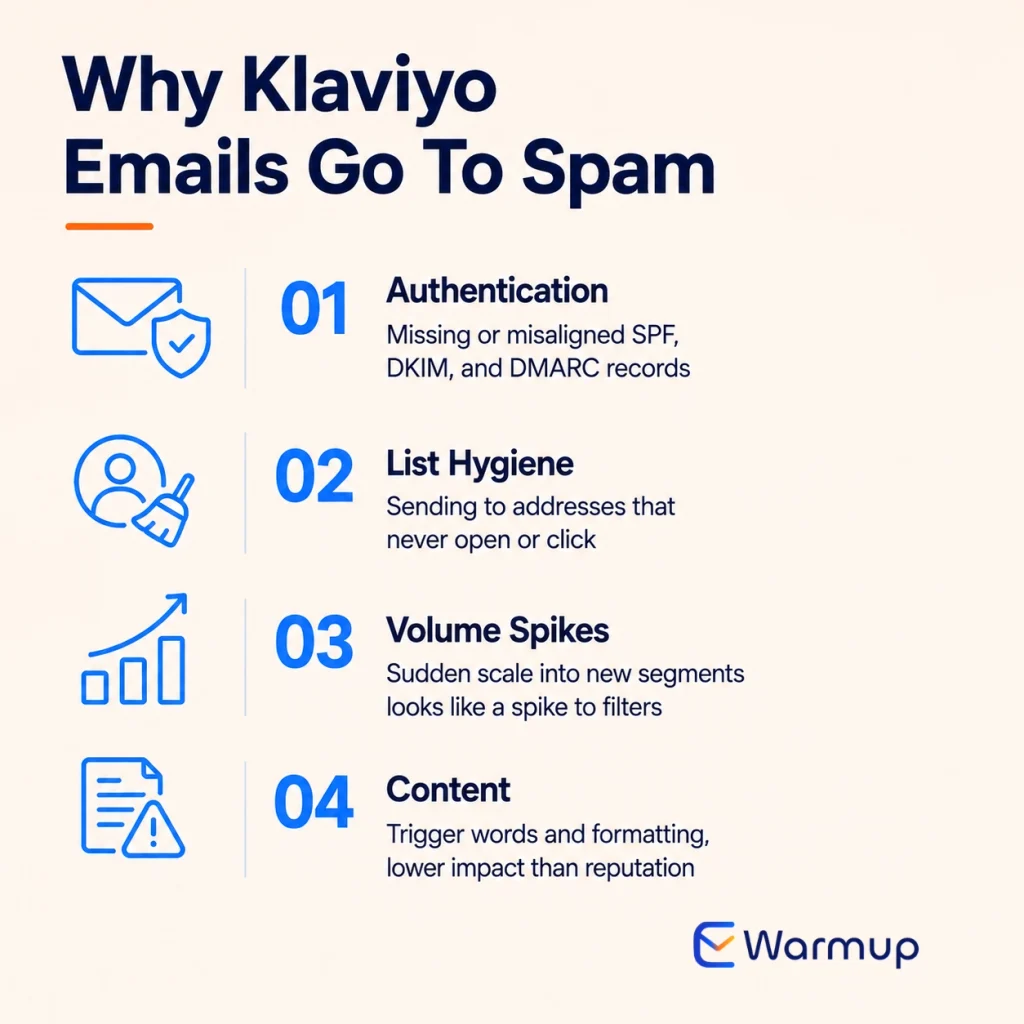
A few common issues account for most Klaviyo deliverability drops. Missing or misaligned SPF, DKIM, and DMARC records are near the top of the list, especially if you’re sending from a shared Klaviyo domain instead of a properly configured branded one.
Poor list hygiene is another frequent cause. Continuing to email addresses that never open or click signals low relevance to inbox providers over time, even if the rest of your setup is clean.
Sudden volume changes matter too. A flow that scales quickly into new segments can look like a spike to a filtering system, even when the growth behind it is entirely legitimate.
Content triggers get blamed often, but usually carry less weight than reputation and authentication issues in practice.
How This Fits With Klaviyo’s Branded Sending Domain
Klaviyo pushes every account toward setting up a branded sending domain instead of relying on Klaviyo’s shared one, and that step matters more than it looks. A shared domain carries the sending history and reputation of every other Klaviyo customer using it, good and bad. A branded domain carries only your own.
That’s an advantage once your reputation is solid, and a blank slate the moment you switch. Migrating to a branded domain without warming it first is a common reason deliverability dips right after what should have been an improvement.
Seed List Warmup fits naturally into that migration. Running it against the new branded domain before, or immediately after, the switch gives inbox providers engagement signals to evaluate instead of nothing at all.
The Gap Most Klaviyo Guides Miss: Sending History
Most advice on this topic focuses on content, list hygiene, and authentication. All of that genuinely matters, but it skips a foundational piece that sits underneath everything else: sending history.
A new sending domain, or a domain that’s gone quiet for a stretch, has no track record for inbox providers to lean on. Even a perfectly configured, well-written campaign can struggle to reach the inbox on a domain that hasn’t earned any trust yet.
Building that trust takes consistent, positive engagement signals over time. It isn’t something authentication or a cleaner list alone can produce.
Why You Can’t Just “Warm Up” Klaviyo the Normal Way
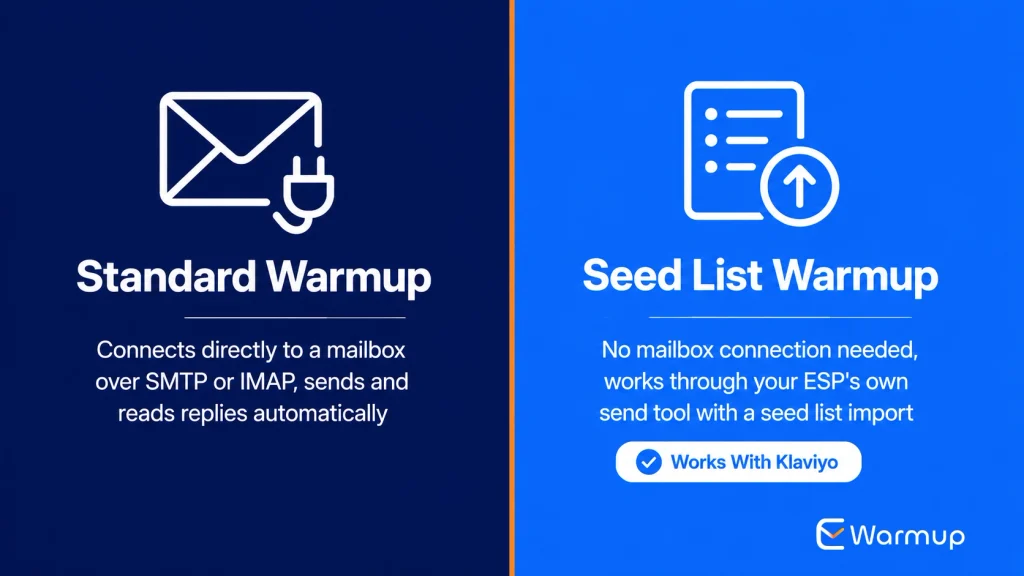
Standard warmup tools connect to a mailbox over SMTP or IMAP. They send warmup traffic from that mailbox and read replies back through it.
Klaviyo doesn’t hand out that kind of access, since it sends on your behalf from its own infrastructure. That means the usual warmup process has nothing to connect to.
The reputation problem it would normally solve still exists. It just needs a different mechanism to fix it.
Fixing It With E-Warmup’s Seed List Warmup – Klaviyo Emails Going to Spam
This is where E-Warmup comes in. Its Seed List Warmup feature is built specifically for platforms like Klaviyo that don’t offer SMTP access. No SMTP? Warm up anyway.
Instead of connecting a mailbox, E-Warmup gives you access to curated lists of real, engaged seed inboxes across Gmail, Outlook, Yahoo, and other major providers. You import that list into Klaviyo as a segment and send to it the same way you’d send to any other audience.
Those seed inboxes open, read, click, occasionally get pulled back out of spam, and generate genuine engagement signals in the process. Inbox providers read those signals the same way they’d read engagement from any real subscriber.
Sent consistently over a few weeks, this builds exactly the sending history your real flows and campaigns are missing, without needing SMTP access Klaviyo was never going to provide.
Klaviyo isn’t the only closed platform this fixes. The same method works on any ESP that won’t hand out SMTP credentials, from Shopify Email and Omnisend to HubSpot and Mailchimp. If you’re running email across more than one of these, it’s worth reading how Seed List Warmup works platform-wide rather than treating each one as a separate problem.
What This Looks Like in Practice
The process runs alongside your normal Klaviyo workflow rather than replacing anything.
- Enter the exact sender address you send Klaviyo campaigns from, on the domain you’re warming up
- Download a fresh seed list (CSV) from your E-Warmup dashboard
- In Klaviyo, go to Lists & Segments, then Create List, and import the CSV as its own list, kept separate from your real subscribers
- Copy E-Warmup’s tracking code into the email body of the campaign you’re sending to that list, then confirm the checkbox in E-Warmup confirming the code has been added
- Send the campaign in Klaviyo to the seed list only, then return to E-Warmup and click Start Warmup
From there, the seeds engage automatically over the following days, and you can track placement and engagement results on your E-Warmup dashboard as they come in, since Klaviyo’s own analytics won’t show inbox placement.
One detail that trips people up: credits are consumed when you download the seed list, not when you send. Downloading a 200-seed CSV uses 200 credits regardless of whether that campaign goes out the same day or a week later.
What a Klaviyo Seed List Campaign Costs on E-Warmup
Seed List Warmup is sold as one-time credits, not a subscription, and credits never expire once purchased. Pricing scales with list size, starting small enough to test on a single Klaviyo campaign.
| Seeds | Price |
| 50 | $6 |
| 100 | $11 |
| 200 | $19 |
| 400 | $28 |
| 600 | $37 |
| 800 | $46 |
| 1,000 | $55 |
E-Warmup also groups these into named packs if you’d rather pick by scenario than by exact seed count. Warmup Launch, 200 seeds for $19, works for a first test. Warmup Campaign, 600 seeds for $37, works for an ongoing rebuild. Warmup Session, 1,000 seeds for $55, works for a more thorough, provider-level read. Larger or recurring needs can be handled with a custom or done-for-you pack.
For an initial Klaviyo domain warmup, a 200-seed list is usually enough to get a reliable, provider-level read on where you’re landing across Gmail, Outlook, and Yahoo.
Mistakes That Slow Klaviyo Warmup Down
A handful of setup errors account for most of the delayed or inconsistent results senders run into.
- Sending the warmup campaign to a real Klaviyo flow or segment instead of the seed-only list
- Using a sender address that doesn’t match the branded domain you’re actually trying to warm up
- Editing or removing the tracking code from the email body after it’s already been added
- Reusing an old seed CSV instead of downloading a fresh one before each new send
- Jumping straight to a large seed list on a brand-new or previously-flagged domain instead of scaling up gradually
None of these are hard to avoid once you know they’re there, but they’re also the reason two people running the same warmup process end up with different results.
Klaviyo Deliverability FAQ
Why are my Klaviyo emails suddenly going to spam when nothing changed?
The most common reason is a shift in engagement or sending pattern that inbox providers picked up on, even when your Klaviyo configuration itself hasn’t changed. A domain with limited sending history is especially sensitive to this, since providers have less established trust to fall back on when something shifts.
Do I need SPF, DKIM, and DMARC set up before trying to fix deliverability?
Yes. Authentication needs to be correctly configured and aligned with your Klaviyo sending domain first. Building sending history on top of broken or misaligned authentication won’t produce reliable results.
Does Seed List Warmup replace SPF, DKIM, and DMARC setup?
No. Authentication and warmup solve different problems. SPF, DKIM, and DMARC prove your emails are legitimately from your domain. Seed List Warmup builds the engagement history that tells inbox providers your domain is trusted, not just authenticated. Both need to be in place together.
Will cleaning my list fix the problem on its own?
List hygiene helps, but it addresses a different part of the problem than sending history does. A clean list sent from a domain with no track record can still struggle to reach the inbox, since providers are evaluating both factors independently.
How do I import a seed list into Klaviyo?
In Klaviyo, go to Lists & Segments and create a new list, then import the CSV you downloaded from your E-Warmup dashboard. Keep it as a dedicated list, separate from your real subscribers, so warmup sends never mix with live campaigns.
How fast does E-Warmup’s Seed List Warmup actually improve placement?
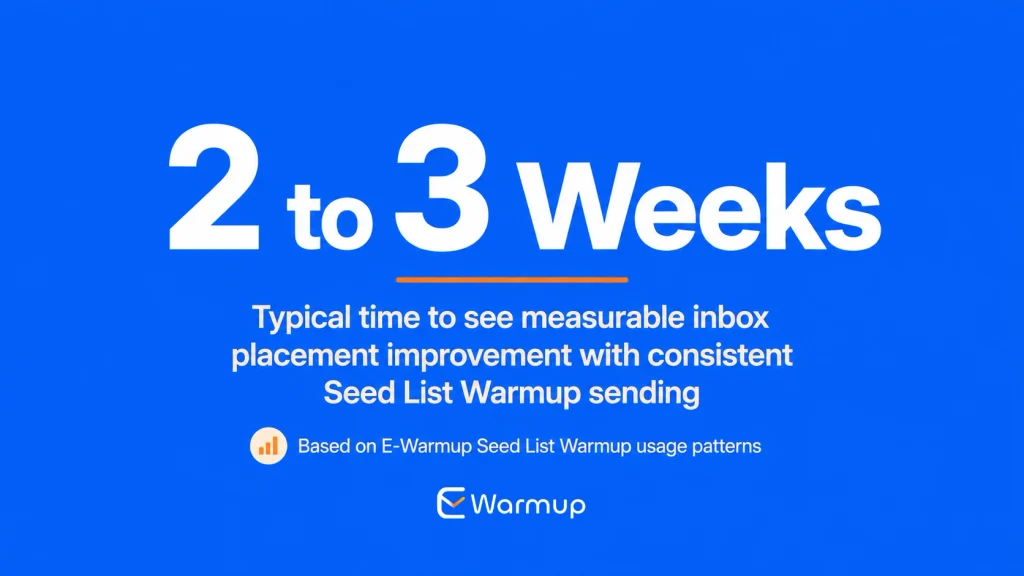
Most senders see measurable improvement within two to three weeks of consistent sending. A domain recovering from a recent deliverability drop typically takes longer than a domain starting fresh.
Does this work for automated flows, or only for one-off campaigns?
Seed lists are sent as their own segment, so they’re typically run as a dedicated campaign rather than folded directly into an automated flow. Once your domain’s overall reputation improves, that benefit carries over to your flows automatically.
The Bottom Line
Klaviyo isn’t the problem, and neither is your content, most of the time. The real gap is sending history, and that’s the one thing standard advice about authentication and list hygiene can’t build on its own.
E-Warmup’s Seed List Warmup closes that gap directly, using real inboxes rather than API flags to generate the engagement Klaviyo can’t produce on its own. You buy credits once, they never expire, and you only spend them on the campaigns you actually send.
Related Reading

Instantly Alternatives: What Instantly, Smartlead, and Woodpecker’s Built-In Warmup Actually Does
Sending History 101: How Inbox Providers Judge Your Email Domain Reputation
Click Rate vs Click Through Rate: Why the Same Campaign Shows Two Different Numbers