
Quick Answer
A dashboard showing 100% health and a campaign landing in spam are not supposed to happen at the same time, but they do, constantly. Most tools calling themselves an email reputation checker are measuring basic account status, not the multi-signal trust score that inbox providers actually use to decide where mail lands.
- A 100% score often just means “account works”, not “inbox providers trust this domain”
- Real reputation pulls from multiple sources: authentication, engagement, complaints, bounces, blacklist status
- Static scores rarely move, even when something real changes, like a blacklist hit
- Even named tools admit this gap directly: MailReach’s own help center has an article addressing why a high score can still mean spam placement
You checked your score. It said 100%. You sent the campaign anyway, because why wouldn’t you, and it landed in Promotions or Spam regardless. This isn’t a rare glitch. It’s a predictable outcome of what most reputation checkers are actually built to measure.
What a 100% Health Score Is Actually Measuring
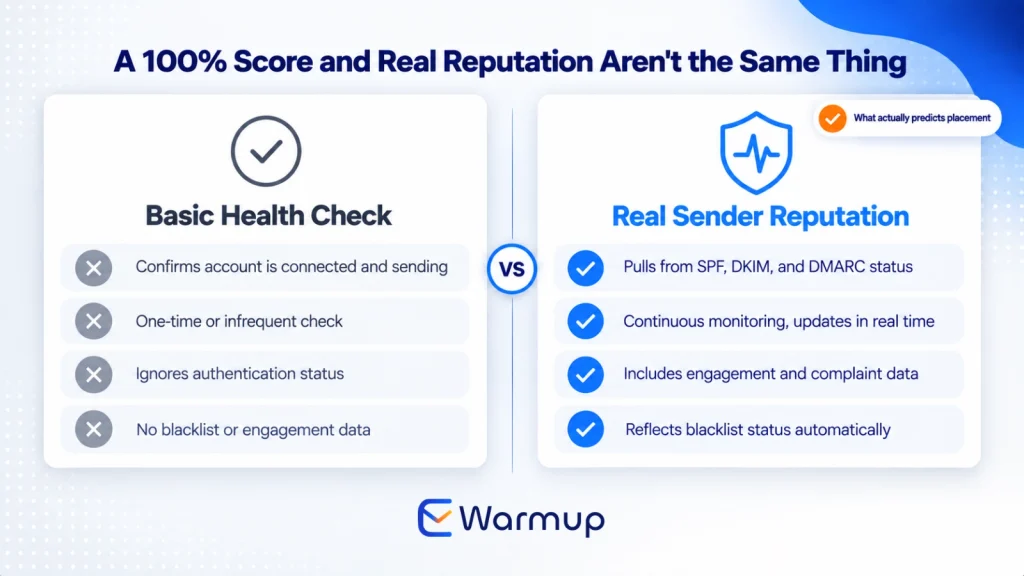
Most tools labeled an email reputation checker are running a basic status check: is the account connected, is it sending and receiving normally, has it triggered any obvious red flags. That’s a real check, and it’s useful.
It’s also a very different thing from what Gmail, Outlook, or Yahoo are evaluating when they decide where your email lands. A “100%” or “healthy” reading typically confirms the account itself is functional, not that inbox providers have extended it any particular trust.
This is why the number so often stays flat. If nothing about the account’s basic connectivity has changed, the score doesn’t move, regardless of whether your actual placement rate quietly dropped over the same period.
Why This Number Doesn’t Track Real Deliverability
A basic health check usually has no direct connection to the things that actually determine inbox placement. Authentication status, SPF DKIM DMARC often aren’t factored in at all.
Engagement quality, whether real recipients are opening, replying, or marking messages as spam, isn’t part of a simple account-status check either. Neither is blacklist presence, which can sink placement even when everything else about a domain looks fine.
MailReach’s own help center addresses this gap directly, with an article titled explaining why a sender can show a high reputation score and still land in spam. That’s a named tool admitting, in its own documentation, that the score and actual placement aren’t the same thing.
Most health checks also run once and stay static, rather than continuously reassessing. A domain that lands on a blacklist the day after a check was run can keep showing a clean, unchanged score for weeks, since nothing prompted a recheck.
Going deeper on this: Why Your Outreach Tool’s Warmup Feature Isn’t Actually Warming Anything Up
This same gap, between a reassuring dashboard number and what’s actually happening with real inbox providers, is the subject of a full breakdown. That piece covers the warmup side of the problem. This one covers the reputation-checker side.
What a Real Reputation Signal Actually Looks Like
A genuine reputation score pulls from several inputs at once, not a single account-status flag. Validity’s Sender Score, one of the more established independent scoring systems, rates domains from 0 to 100 based on spam complaint rates and sending volume together, not connectivity status.
Google Postmaster Tools works similarly from Gmail’s own vantage point, reporting spam rate, authentication results, and a domain reputation trend directly from the provider that’s actually filtering your mail.
The historical correlation between score and outcome is well documented. Senders scoring in the 91 to 100 range on Sender Score have historically averaged spam complaint rates under 1%, while senders in the 81 to 90 range averaged rates roughly five times higher, according to Return Path research now maintained by Validity.
A real signal also moves when something real happens. A sudden bounce spike, a fresh blacklist listing, or a drop in engagement should visibly shift the number, not leave it sitting at the same reading it had a month ago.
What E-Warmup’s Reputation Score Actually Pulls From
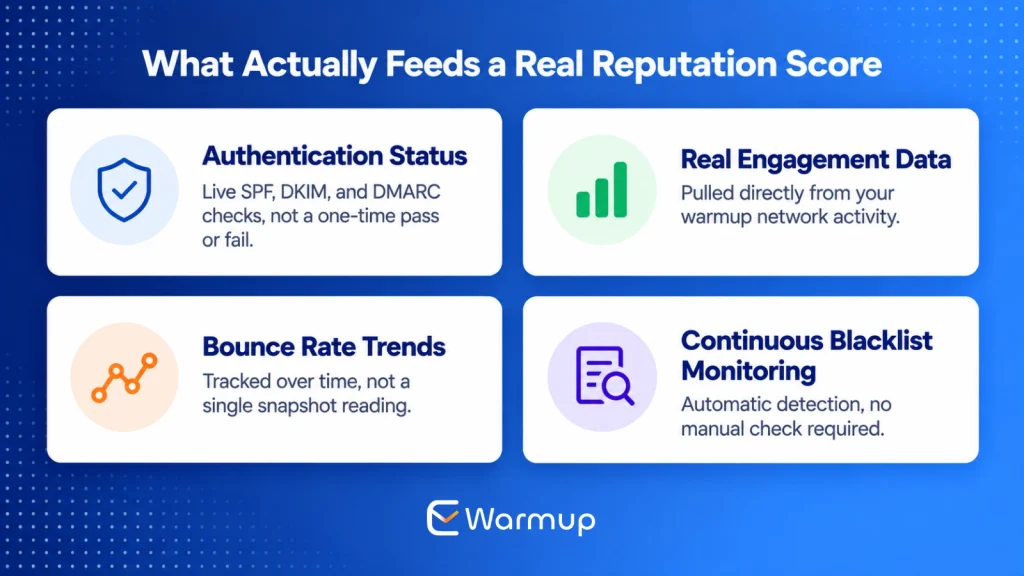
E-Warmup’s sender reputation checker doesn’t run a single, one-time snapshot. It’s built from multiple live signals: authentication status across SPF DKIM DMARC; real engagement data from the warmup network; bounce-rate trends; and continuous blacklist monitoring with automatic detection rather than a manual, on-request check.
That last piece matters most against the “100% and static” problem this blog is about. A domain can slide onto a blacklist mid-week, and most tools won’t catch it until someone thinks to run a check. E-Warmup’s blacklist monitoring runs continuously, so a listing shows up in the score without anyone needing to go looking for it.
The DNS and inbox placement testing included on every plan, including Free Forever, work the same way, checking authentication and real placement across Gmail, Outlook, and Yahoo specifically, rather than reporting one blended number that hides which provider is actually the problem.
How to Tell the Difference Before You Trust the Dashboard
A few direct questions separate a genuine email domain reputation signal from a cosmetic status check.
Ask what specifically feeds the score. If the honest answer is “whether the account is connected and sending,” that’s a functionality check, not a reputation score. A real one should name authentication, engagement, complaints, and blacklist status as inputs.
Check whether it updates after a real event. Trigger something observable, a bounce spike, a known blacklist listing, and see if the score reflects it within a reasonable window. If the number stays identical regardless, it isn’t tracking the thing you actually care about.
Look for per-provider detail, not one blended number. Gmail, Outlook, and Yahoo evaluate senders differently. A single flat score that doesn’t break down by provider is hiding meaningful variation.
Why This Gap Costs More Than a Bad Campaign
The practical cost of trusting a cosmetic score isn’t just one underperforming send. It’s the wrong conclusion that follows it.
A team that checks their email health score, sees it reading fine, and still watches a campaign underperform usually blames the content, the list, or the channel itself. The actual cause, a domain with real authentication gaps or a quiet blacklist hit that the dashboard never surfaced, goes unaddressed.
This is the same pattern covered across email warmup tools generally, and it’s the mechanism behind why a reassuring number and real inbox placement so often disagree.
Email Reputation Checker FAQ
Why does my email reputation checker show 100% while my campaigns land in spam?
Most tools showing a flat 100% or “healthy” reading are confirming basic account connectivity, not real inbox provider trust. Authentication status, engagement quality, and blacklist presence often aren’t part of that calculation at all, which is why the two numbers can diverge completely.
What’s the difference between an email health score and email sender reputation?
A health score, as most tools use the term, typically reflects whether an account or feature is functioning normally. Sender reputation is a broader, provider-facing signal built from authentication, engagement behavior, complaint rates, and blacklist status, the actual inputs inbox providers use to decide placement.
How often should a real reputation score update?
A genuine signal should reflect changes close to when they happen, not just on a fixed schedule. If a blacklist listing or a bounce spike doesn’t move the number within a reasonable window, the score isn’t tracking real-time conditions.
Can a domain have good authentication but still show poor sender reputation?
Yes. SPF DKIM DMARC confirm identity, not trust. A fully authenticated domain can still carry a poor reputation if its sending history includes high complaint rates, blacklist incidents, or weak engagement.
Is Google Postmaster Tools a reliable email reputation checker?
Yes, since it reports directly from Gmail’s own perspective, including spam rate and a domain reputation rating. It’s specific to Gmail, though, so it won’t reflect how Outlook or Yahoo separately view the same domain. Read our guide to Google Postmaster Tools V2: What Changed.
Why do some tools’ health scores never seem to change?
Because many are running a one-time or infrequent status check rather than continuous monitoring. If nothing prompts a recheck, the number can stay flat for weeks even as real conditions, like engagement or blacklist status, shift underneath it.
The Bottom Line
A 100% reading and a spam folder placement aren’t contradictory once you understand what most checkers are actually built to measure. A flat number confirming an account works is a different thing entirely from a real, multi-signal reputation score that reflects how inbox providers actually see your domain.
E-Warmup’s reputation score pulls from authentication, engagement, and blacklist data continuously, not a static account status check, so it moves when something real actually changes.

Related Reading
- 15 Email Deliverability Statistics Every Sender Needs to Know in 2026 — benchmark data on sender reputation and inbox placement.
