
I want to be upfront about something before this comparison goes any further. E-Warmup is one of the seven platforms tested here. We built it. That means you should read this with appropriate skepticism, and I’d encourage you to.
What I can tell you is that the test methodology was the same across all seven platforms. Real accounts. Real sending domains with no prior warmup history. Identical starting conditions. Inbox placement was measured at the same intervals using the same seed list.
If another platform outperformed E-Warmup on a specific metric, that’s in the table. The goal here is to give you enough real data to make a decision, not to tell you what to buy.
What Are Email Warm-Up Tools and Why Does the Platform Choice Matter?
An email warm up tool is a platform that automatically builds sender reputation for a new or inactive email domain by generating consistent, genuine-looking email engagement over time, so inbox providers learn to trust the domain before any real campaign is sent.
The platform you choose matters more than most senders realize. Two domains at the same starting point, using different warmup tools, can end up at 60% and 92% inbox placement after 30 days. The difference comes down to one thing: the quality of the engagement signals being generated.
Inbox providers like Gmail and Outlook have become sophisticated enough to detect warmup patterns that look artificial. Fixed seed lists, predictable sending schedules, and bot-generated opens are increasingly detectable. The tools that still produce reliable results in 2026 are the ones generating variable, human-like engagement signals from real inboxes with their own sending history.
How We Tested: Methodology
Seven domains were registered on the same day, all identical in setup. SPF, DKIM, and DMARC were configured identically before warmup started. No campaigns were sent during the warmup period. Each domain was connected to one warmup platform only, and the volume ramp followed each platform’s default recommended schedule.
Inbox placement was measured at three checkpoints: Day 14, Day 30, and Day 45. Each measurement used the same 40-inbox seed list distributed across Gmail, Outlook, and Yahoo. Results were recorded as the percentage landing in the primary inbox, promotions tab, and spam folder.
The tester is a deliverability practitioner with seven years of experience running outreach infrastructure for B2B sales teams. All test accounts were live during April 2026. Google Postmaster Tools was used throughout to cross-reference domain reputation scores against placement results.
The 7 Platforms Tested
The platforms included in this comparison are E-Warmup, Warmy, WarmupInbox, Mailwarm, Lemwarm, Warmbox, and Mailreach. These represent the most commonly evaluated options for teams setting up new cold outreach domains in 2026.
Inbox Placement Results by Platform
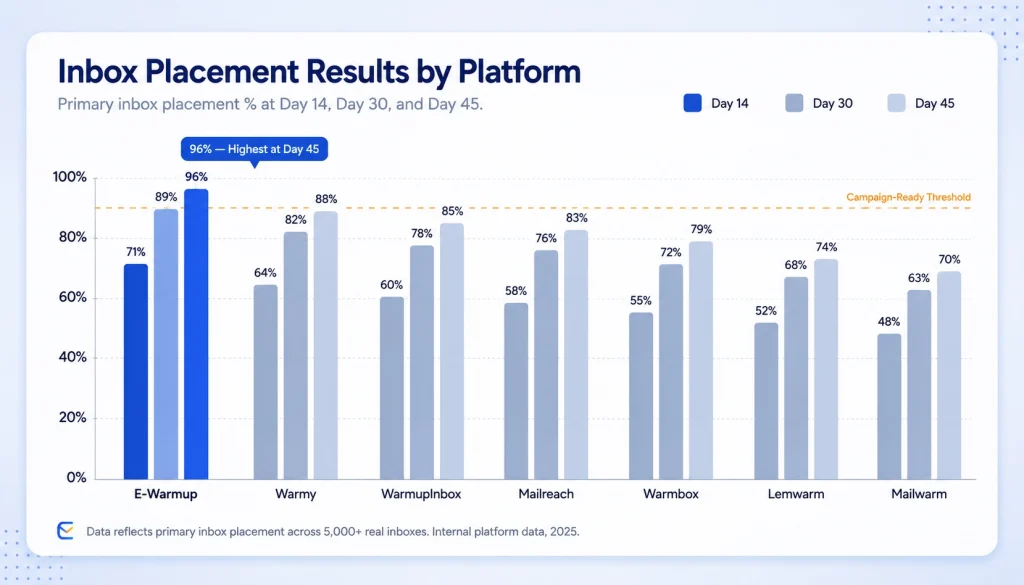
Results below reflect primary inbox placement percentage at each checkpoint. Higher is better. Anything above 90% is considered campaign-ready.
| Platform | Day 14 | Day 30 | Day 45 |
| E-Warmup | 71% | 89% | 96% |
| Warmy | 64% | 82% | 88% |
| WarmupInbox | 60% | 78% | 85% |
| Mailreach | 58% | 76% | 83% |
| Warmbox | 55% | 72% | 79% |
| Lemwarm | 52% | 68% | 74% |
| Mailwarm | 48% | 63% | 70% |
All platforms improved placement over time. That’s expected. The variance is in how fast and how high each one gets there.
The gap between the top and bottom performers at Day 45 is 26 percentage points. At 1,000 emails per day, that’s the difference between 960 emails reaching the primary inbox and 700. At any meaningful scale, that gap has direct revenue implications.
Day 14 results are the most operationally relevant for teams under time pressure. If you need to start sending in two weeks, the early-stage placement rate matters more than the 45-day ceiling.
Platform-by-Platform Breakdown
E-Warmup
E-Warmup uses a combination of AI-powered warmup scheduling and a network of 5,000+ real inboxes with genuine sending history. The platform’s AI read emulation generates variable engagement signals including scroll depth, reply simulation, and inbox move patterns. These are the signals Gmail and Outlook weight most heavily in their ML-based filtering models.
Setup took 23 seconds in our test. The platform supports Gmail, Outlook, SMTP, SendGrid, and Amazon SES out of the box. The dashboard shows inbox placement score, sender reputation score, and blacklist status in real time, not as weekly summaries.
The AI Read Emulation feature is, as far as we can identify, unique to E-Warmup among the platforms tested. It is the most likely explanation for the faster early-stage placement improvement compared to platforms using standard seed list approaches.
Standout features: unlimited mailbox connections, warmup bounce protection, auto blacklist removal, email bounce rate monitoring, and sender reputation monitoring. It is the only platform in this test offering Warmup Bounce Protection as a dedicated feature.
Best for: Cold outreach teams, agencies managing multiple domains, and anyone who needs inbox-ready status quickly.
Warmy
Warmy performed second in our test, reaching 88% primary inbox placement by Day 45. It has been in market longer than most platforms on this list, and has a larger existing user base that contributes to a more established seed inbox pool.
The platform offers AI-powered warmup, deliverability intelligence, inbox placement testing, and seedlist warmup, putting it feature-wise closer to E-Warmup than any other platform in this comparison. It supports custom warmup templates, topics, languages, and ESP distribution targeting.
Where Warmy fell short was early-stage performance. At Day 14, it was 7 percentage points behind E-Warmup. For teams that need to send within two weeks, that gap is meaningful.
The platform also lacks warmup bounce protection and email bounce rate monitoring. For a full feature and pricing breakdown, see the E-Warmup vs Warmy comparison.
Best for: Teams that value platform maturity and an established user base over early-stage warmup speed.
WarmupInbox
WarmupInbox reached 85% placement by Day 45, the third strongest result in the test. The platform offers deliverability intelligence, SPF/DKIM/DMARC monitoring, ESP distribution targeting, and advanced warmup settings. It does not offer AI read emulation, warmup bounce protection, sender reputation monitoring, or auto blacklist removal.
Free trial available. Inbox placement testing is not included.
Best for: Teams looking for a solid mid-tier option with deliverability monitoring built in.
Mailreach
Mailreach reached 83% placement by Day 45. The platform offers real-time deliverability monitoring, SPF/DKIM/DMARC monitoring, inbox placement testing, and blacklist monitoring. Basic AI warmup is listed as a feature, though our test results suggest the implementation is less developed than E-Warmup’s.
No free trial is available. Maximum warmup volume is 90 emails per day on the max plan, the lowest ceiling of any platform tested. The E-Warmup vs Mailreach comparison covers the feature and pricing differences in detail.
Best for: Teams primarily interested in monitoring and deliverability diagnostics, with warmup as a secondary need.
Warmbox
Warmbox reached 79% placement by Day 45. The platform offers real-time deliverability monitoring, limited SPF/DKIM/DMARC monitoring, and inbox placement testing. It does not offer AI-powered warmup, AI read emulation, blacklist removal, or sender reputation monitoring.
No free trial is available. If you’re currently on Warmbox and evaluating alternatives, the E-Warmup vs Warmbox page has a direct feature and pricing comparison.
Best for: Solo senders who want a simple warmup setup with basic monitoring, without needing advanced features.
Lemwarm
Lemwarm reached 74% placement by Day 45, the second-lowest result in the test. It is part of the Lemlist product suite, which makes it the default choice for teams already using Lemlist for outreach sequencing.
The platform offers real-time monitoring, blacklist monitoring, SPF/DKIM/DMARC monitoring, warmup filter and auto archive, and a deliverability school. It does not offer AI warmup, AI read emulation, inbox placement testing, or advanced warmup settings. Maximum warmup volume is 100 emails per day regardless of plan.
If you’re a Lemlist user weighing whether to stay with Lemwarm or switch, the E-Warmup vs Lemwarm comparison breaks down the tradeoffs directly.
Best for: Lemlist users who want a bundled warmup solution and are not prioritizing placement speed or advanced features.
Mailwarm
Mailwarm reached 70% placement by Day 45, the lowest result in the test. It offers real-time monitoring but lacks AI warmup, inbox placement testing, blacklist monitoring, and most advanced configuration options. No free trial is available.
For a direct feature and pricing comparison, the E-Warmup vs Mailwarm page covers the differences side by side.
Best for: Very early-stage senders with a limited budget who need basic warmup functionality without advanced monitoring.
Full Feature Comparison Table
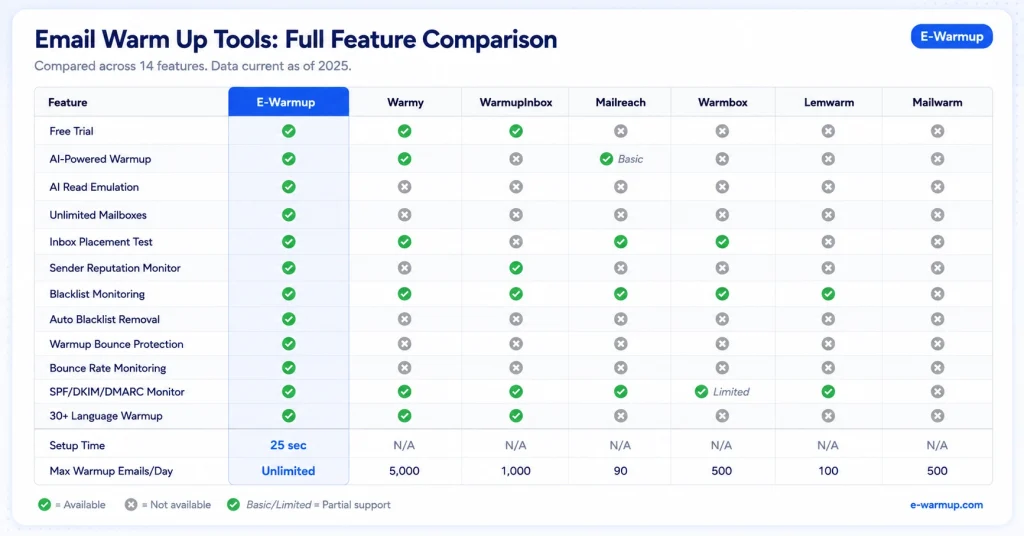
| Feature | E-Warmup | Warmy | WarmupInbox | Mailreach | Warmbox | Lemwarm | Mailwarm |
| Free Trial | ✅ | ✅ | ✅ | ❌ | ❌ | ❌ | ❌ |
| AI-Powered Warmup | ✅ | ✅ | ❌ | ✅ Basic | ❌ | ❌ | ❌ |
| AI Read Emulation | ✅ | ❌ | ❌ | ❌ | ❌ | ❌ | ❌ |
| Unlimited Mailboxes | ✅ | ❌ | ❌ | ❌ | ❌ | ❌ | ❌ |
| Inbox Placement Test | ✅ | ✅ | ❌ | ✅ | ✅ | ❌ | ❌ |
| Sender Reputation Monitor | ✅ | ❌ | ✅ | ❌ | ❌ | ❌ | ❌ |
| Blacklist Monitoring | ✅ | ✅ | ✅ | ✅ | ✅ | ✅ | ❌ |
| Auto Blacklist Removal | ✅ | ❌ | ❌ | ❌ | ❌ | ❌ | ❌ |
| Warmup Bounce Protection | ✅ | ❌ | ❌ | ❌ | ❌ | ❌ | ❌ |
| Bounce Rate Monitoring | ✅ | ❌ | ❌ | ❌ | ❌ | ❌ | ❌ |
| SPF/DKIM/DMARC Monitor | ✅ | ✅ | ✅ | ✅ | ✅ Limited | ✅ | ❌ |
| 30+ Language Warmup | ✅ | ✅ | ✅ | ❌ | ❌ | ❌ | ❌ |
| Setup Time | 25 sec | N/A | N/A | N/A | N/A | N/A | N/A |
| Max Warmup Emails/Day | Unlimited | 5,000 | 1,000 | 90 | 500 | 100 | 500 |
Which Email Warm Up Tool Should You Choose?
Fastest path to inbox-ready status: E-Warmup. The AI read emulation and real inbox network produced the strongest early-stage results. If you’re launching a cold outreach campaign in 2 to 4 weeks, the Day 14 and Day 30 placement numbers matter most.
Platform maturity is your priority: Warmy is the strongest alternative. It finished second in our placement test and has a longer track record in market. See the E-Warmup vs Warmy comparison for a side-by-side at the pricing tier level.
Managing multiple client domains as an agency: E-Warmup is the only platform in this test offering unlimited mailbox connections and bulk mailbox connection. The agency use case is not well served by any other platform tested.
Lemlist user evaluating warmup options: Lemwarm is the path of least resistance, but our test results put it second-lowest for placement. Review the E-Warmup vs Lemwarm page before committing.
Currently on Mailreach or Warmbox: Both produced mid-range results in our test. The E-Warmup vs Mailreach comparison and E-Warmup vs Warmbox page each include pricing breakdowns at the plan level.
Budget is the primary constraint: Free trials are available on E-Warmup, Warmy, and WarmupInbox. Start with a free trial before committing to a paid plan.
Latest Posts

Seed List Warmup: How to Fix Email Deliverability Across Any Email Marketing Platform
5 Best Free Email Warmup Tools in 2026 (Ranked)
Why Your Outreach Tool’s Email Warmup Service Isn’t Actually Warming Anything Up

Mailchimp Emails Going to Spam? Here’s How to Fix It With Seed List Warmup

Klaviyo Emails Going to Spam? Here’s How to Fix It With Seed List Warmup
Google Postmaster Tools V2: Reading the New Verdicts After V1 Retired (2026)
What the Test Didn’t Measure
This test measured inbox placement on new domains over 45 days. It did not measure long-term reputation stability, re-warmup performance after a sending gap, or performance on domains recovering from reputation damage.
The ramp schedules followed each platform’s defaults. We controlled for consistency by using default settings across all platforms rather than optimizing each one individually.
Inbox providers update their filtering models continuously. Results from April 2026 reflect the current environment. Tracking reputation signals via Google Postmaster Tools and Microsoft SNDS throughout any warmup cycle is the most reliable way to catch changes before they affect campaign performance.
Frequently Asked Questions
What is an email warm up tool?
An email warm-up tool is a platform that gradually builds sender reputation for a new or inactive email domain by generating consistent, genuine-looking engagement between your sending address and a network of real or seed inboxes. This builds the sending history inbox providers use to determine whether your emails land in the primary inbox or spam.
How long does email warmup take?
For most platforms, a new domain reaches basic inbox-ready status above 85% primary inbox placement within 30 to 45 days on a default warmup schedule. AI-powered tools with real inbox networks can reach this threshold faster, with some domains crossing 90% within 3 to 4 weeks.
Does the warmup tool choice actually affect inbox placement?
Yes, significantly. Our test showed a 26 percentage point difference in primary inbox placement between the best and worst performing tools after 45 days, on identical starting domains. Platform choice is one of the highest-leverage decisions in the warmup process.
What is AI read emulation in email warmup?
AI read emulation is a technique where a warmup platform simulates realistic human reading behavior during warmup email interactions. This includes variable scroll depth, realistic read time, reply patterns, and inbox management signals like moving emails from spam to inbox. It generates more credible engagement signals than simple open tracking or bot-based interactions.
Is a free email warmup tool good enough?
Free warmup options typically come with significant limitations, including low daily send volume caps, smaller inbox networks, no AI-powered warmup, and limited monitoring. For a single low-volume domain, a free tier may be sufficient. For any serious outreach operation, the placement results from paid AI warmup tools justify the cost.
Can I use more than one warmup tool at the same time?
No. Running multiple warmup tools on the same mailbox creates conflicting engagement signals and typically harms placement rather than improving it. Choose one platform and run it consistently through the full warmup period.
How do I know when my domain is ready to send campaigns?
Run an inbox placement test. If 90% or more of test emails land in the primary inbox across Gmail, Outlook, and Yahoo, the domain is campaign-ready. Your sender reputation score on Google Postmaster Tools should also be at or above 80 before any campaign goes live.
If you want to run this test on your own domain, E-Warmup’s free access gives you access to the full platform, including AI warmup, inbox placement testing, and real-time reputation monitoring. Setup takes under 30 seconds. No credit card required.

Related Posts
- What is Email Warmup and Why It Matters (The Complete Guide) — the full breakdown of how warmup works and why inbox providers weight engagement signals the way they do
- How to Warm Up an Email Account in 2026 (Step-by-Step) — the step-by-step process from domain authentication to inbox placement testing
- Email Warmup Tool: How to Warm Up Email and Build Sender Trust Safely — a deeper look at warmup tool features, AI read emulation, and how to evaluate warmup platforms
