
Quick Summary
Among free email warmup tools, E-Warmup ranks best in 2026, the only option offering a genuine free-forever tier on a real, full-scale inbox network, not a limited pool or a countdown trial.
- Free Forever, not a trial: No credit card required, no expiration date, ever.
- Runs on the real network: 40,000+ inboxes, the same network paid plans use.
- Free tools included regardless of plan: Email Spam Checker, SPF Record Generator, and DMARC Record Generator, all free forever.
- Real sending history, not a pool score: Built around your own email copy, not generic content measured against a closed pool.
Free email warmup tools mean something different depending on which product page you land on. Some give you a genuine free-forever tier. Others give you a trial and call it free. A third category is bundled into outreach platforms you’re already paying for and shows a reassuring “100% health” number that doesn’t reflect what’s actually happening once you send a real campaign.
This guide covers five real free options first, what “free” actually means for each one, then walks through why the free warm-up bundled into platforms like Instantly, Smartlead, and Woodpecker is a fundamentally different, weaker mechanism, one that measures the wrong thing entirely.
Before comparing tools, it helps to separate three things that get lumped together under the same label. A free trial gives you full access to a paid tool for a limited window, then requires payment to continue.
A free-forever tier gives you ongoing access with no expiration, usually with a volume cap. And warmup bundled into a paid outreach platform is included at no extra charge, but only if you’re already paying for the platform itself.
5 Free Email Warmup Tools Compared
1. E-Warmup, Free Forever
E-Warmup’s Free Forever plan gives you one mailbox with 10 warmup emails per day, 5 DNS score tests a month, and 5 inbox placement tests a month, running on the same network of 40,000+ real inboxes that E-Warmup’s paid tiers use.
No credit card is required, and there’s no expiration date.
Key features included free: Seedlist warmup, bounce rate monitoring, sender reputation checker, deliverability monitoring, warmup filter with auto-archive, and free access to E-Warmup’s standalone Email Spam Checker, SPF Record Generator, and DMARC Record Generator, regardless of plan.
This last piece matters more than it sounds, since most competitors gate authentication diagnostics behind a paid tier entirely.
Best for: Solo senders, freelancers, and small teams who want an ongoing free option rather than a countdown, and who want the free tier to run on the same real inbox network as the paid plans.
2. TrulyInbox, Free-Forever Tier
TrulyInbox offers a genuine free-forever tier as well, capped at 10 warm-up emails a day on a single account. TrulyInbox describes its own pricing model plainly: “pay for emails sent, not accounts connected.”
That means their paid Starter plan’s 200 emails/day is a shared total, not a per-mailbox guarantee. Connect one account, and you get all 200. Connect five, and you’re splitting that same 200, roughly 40 each.
Independent reviews describe this as enough to test the tool and see the dashboard work, but too small a starting point for a mailbox about to launch real outreach volume.
Best for: Testing the tool on a single mailbox. The value proposition weakens quickly once you connect more than one or two accounts.
3. Warmup Inbox, Free Trial
Warmup Inbox runs a free trial with no credit card required, then moves to paid pricing around $15 to $19 per inbox per month depending on billing frequency.
Its own site states a network of 30,000+ real inboxes, and it supports connecting almost any mailbox provider in standalone mode.
Best for: A quick, no-commitment test before evaluating per-inbox pricing against other tools.
4. Mailivery, Free Trial
Mailivery offers a 7-day free trial on flat-rate pricing starting around $29 a month for unlimited mailboxes.
The flat-rate structure matters if you’re planning to scale past one or two mailboxes later, since it doesn’t charge per inbox the way several competitors on this list do.
Best for: Agencies or teams anticipating growth past a handful of mailboxes.
5. Lemwarm, Bundled Free With lemlist
Lemwarm doesn’t offer a standalone free trial. It’s included free with every paid lemlist subscription, per lemlist’s own pricing page, rather than being something you can trial independently.
Pricing runs through lemlist’s own plans, starting around $29 a month on the Essential tier.
Best for: Existing or prospective lemlist users who want warmup bundled into a workflow they’re already paying for.
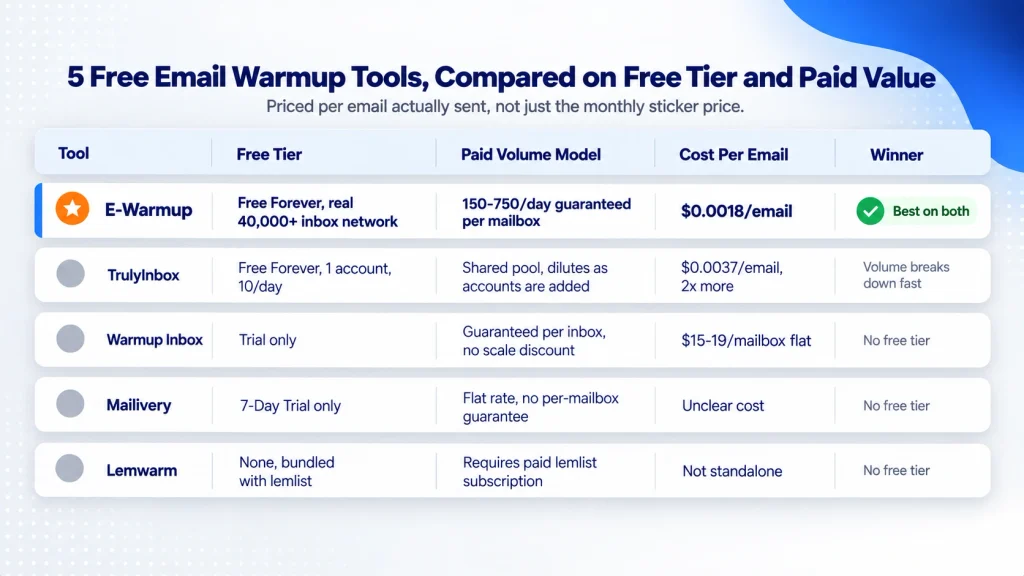
| Tool | Free Tier | Paid Plan Volume Model | Cost Per Email (Paid) | Winner? |
| E-Warmup | Free Forever, real 40,000+ inbox network, no card | 150-750/day guaranteed per mailbox, scales cleanly with mailboxes added | ~$0.0018/email | ✅ Best on both free and paid |
| TrulyInbox | Free Forever, but only 1 account, 10/day | Shared pool, dilutes as accounts are added, 200/day drops to 40/day at 5 mailboxes | ~$0.0037/email, 2x more expensive | Free tier exists, but volume model breaks down fast |
| Warmup Inbox | Trial only, no ongoing free option | Guaranteed per inbox, but priced per inbox with no volume discount at scale | $15-19/mailbox flat | No free tier at all |
| Mailivery | 7-day trial only | Flat rate, unlimited mailboxes, no stated per-mailbox volume guarantee | Unclear, no transparent per-email cost | No free tier at all |
| Lemwarm | None, bundled into lemlist only | Requires active paid lemlist subscription | Tied to lemlist plan, not standalone | No free tier at all |
Why E-Warmup Wins on Both Fronts
On the free tier, the comparison is straightforward. E-Warmup and TrulyInbox are the only two genuine free-forever options in this list, everything else is a time-limited trial or bundled into a paid platform.
Between the two, E-Warmup runs on the exact same 40,000+ real inbox network used by its paid plans, not a scaled-down pool set aside for non-paying users.
On the paid tier, the gap is bigger than the sticker price suggests. TrulyInbox’s lower monthly number looks appealing until you connect more than one mailbox, since its “unlimited accounts” pricing is really a fixed daily budget split more ways as you scale.
Five mailboxes on TrulyInbox’s Starter plan means roughly 40 emails a day each. Five mailboxes on E-Warmup’s Basic plan means 150 emails a day each, the full guaranteed rate, every time.
Priced per email actually sent, E-Warmup comes out to roughly half the cost of TrulyInbox once volume dilution is accounted for.
Connecting Your Mailbox Takes About Two Minutes
Whichever tool you choose from the list above, connection shouldn’t be the hard part. On E-Warmup, connecting Gmail comes down to three quick steps: turn on 2-step verification, generate an app password from your Google account, then paste that password into E-Warmup instead of your regular login.
No custom SMTP configuration, no IT ticket.
The same style of guide exists for Google Workspace, Yahoo, Microsoft 365, Outlook, Zoho, and any custom SMTP provider.
Whichever mailbox you’re warming, the setup follows the same short pattern rather than requiring a different process per provider.
The Knowledge Gap Most Senders Don’t Know Exists
Here’s the part that trips up more senders than any pricing detail on the list above. Most outreach platforms, Instantly, Smartlead, and Woodpecker among them, bundle a warmup feature into their paid plans and show you a health score that looks reassuring, sometimes reading close to 100%.
That number isn’t fake. It’s just measuring something much narrower than most senders assume, and understanding that gap is the difference between a domain that’s actually ready and one that only looks ready on a dashboard.
Instantly’s own help documentation confirms its warmup health score is calculated from engagement inside its own warmup pool over a trailing 7-day window, not from real inbox placement at Gmail or Outlook.
Send 70 warmup emails in a week, have 3 land in spam within that pool, and the score comes out around 95.7%, regardless of how your domain performs with actual inbox providers.
An independent 2026 review found accounts with a healthy internal score still landing in spam once a real campaign went out to real recipients, and noted this gap is documented across multiple independent tests, not an isolated complaint.
Smartlead’s own documentation is explicit that warmup emails have nothing to do with your actual email campaigns. They’re a separate, generic content stream, tracked apart from whatever you actually send to prospects.
Woodpecker’s warmup similarly runs system-generated content through a shared pool, separate from your real campaign copy, according to Woodpecker’s own documentation on the process.
The mechanism behind all three is the same. A generic template gets sent to other accounts in a shared pool, and the pool’s engagement produces a score.
That score tells you the pool liked your account. It says very little about whether your real prospects, at Gmail, Outlook, or Yahoo, will actually see your real email once it goes out.
Why “Bring Your Own Copy” Is the Missing Piece
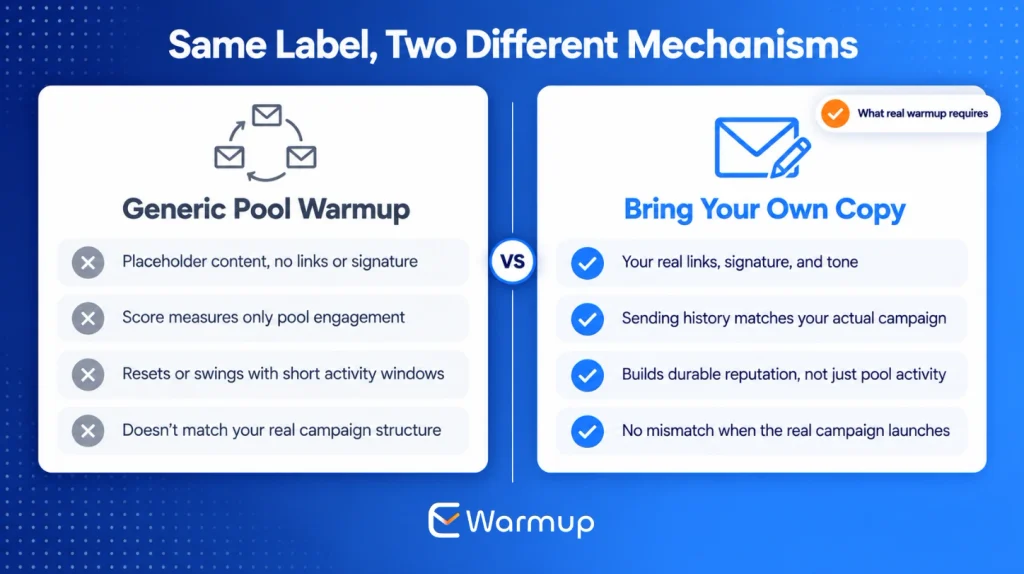
This is the structural gap that explains why a domain can show a great health score and still underperform the moment a real campaign launches.
Generic warm-up tools send placeholder content built for the pool: no links, no signature, no real formatting, nothing resembling what you’ll actually send.
Then the actual campaign goes out with a completely different structure. Links appear. A signature block shows up. The formatting shifts from plain conversational text to something closer to a marketing template.
Inbox providers evaluate content patterns alongside sending history, and that mismatch between your warmup traffic and your real campaign is exactly what they’re built to catch.
Real warmup means sending your own actual email copy from day one, the same links, the same signature, the same tone your real campaign will use.
That way, the sending history being built actually matches what you’re going to send, instead of building trust for an email you’ll never actually use in the field.
This single difference, generic template versus your own copy, is why traditional old-school warmup tools tend just to reduce bounce rate and stabilize an account balance.
A low bounce rate and a healthy-looking balance are real, measurable outcomes. They’re not the same as sender reputation with the providers that decide where your email lands.
Why This Gap Makes People Quit Outreach Entirely
The pattern repeats often enough to name directly. A sender runs a warm-up on a bundled feature, the dashboard shows a strong score, the real campaign underperforms anyway.
The conclusion is that email outreach itself doesn’t work. That’s usually the wrong diagnosis.
The domain never built real sending history in the first place, since the pool score and actual inbox placement were never measuring the same thing to begin with. The channel gets blamed.
The mechanism that never warmed the domain up properly, and never told the sender that, doesn’t. This matters because it’s an expensive misdiagnosis to make.
A team that concludes outreach doesn’t work moves on to a different channel entirely, without ever fixing the underlying gap that caused the underperformance.
What’s Available Once You Outgrow the Free Tier
The free tier covers the starting point. Two paid features are worth knowing about before you hit its limits, since neither is available on Free Forever, and both solve problems the tools above simply can’t.
AI Read Emulation, available on the Growth tier and above, is the mechanism that separates genuine engagement simulation from the basic mark-as-read scripts most warmup tools run on.
Instead of an API call flipping a “read” flag instantly, it physically opens emails with varied timing, dwell behavior, and a believable rate of replies, closer to how a real inbox actually gets checked.
Seed List Warmup solves a completely different problem: platforms that don’t offer SMTP access at all. If your Klaviyo or Mailchimp emails are landing in Promotions or Spam, a standard mailbox-based warmup tool has nothing to connect to.
Klaviyo and Mailchimp send from their own infrastructure, not a mailbox you control, so the usual warmup mechanism simply doesn’t apply.
Seed List Warmup works around this by giving you access to curated lists of real, engaged seed inboxes. You import the list into Klaviyo, Mailchimp, or another platform as a campaign audience and send to it directly.
This runs on one-time credit packs, separate from any mailbox plan, starting at 50 seeds for $6. Credits never expire, and you buy per campaign rather than committing to a monthly subscription, which makes E-Warmup one of the best free email warmup tools out there.
Why E-Warmup Is the Best of the Free Email Warmup Tools
Most of the tools on this list solve “free” with a countdown timer, or bundle a pool-based warmup feature into a paid platform subscription.
E-Warmup and TrulyInbox are the two genuine free-forever standalone options, and between those two, the difference comes down to what the free tier actually gives you.
E-Warmup’s Free Forever plan runs on the same 40,000+ real inbox network as its paid tiers, not a smaller pool reserved for free users. It also includes DNS and inbox placement testing at no cost.
That combination- a real network, genuine free-forever access, free diagnostic tools, and a mechanism built around your own copy rather than generic pool content- is what separates “free” as a marketing label from free as an actual, sustainable starting point.

Best Email Warmup Tools in 2027: 7 Compared and Ranked

Instantly Alternatives: What Instantly, Smartlead, and Woodpecker’s Built-In Warmup Actually Does

Sending History 101: How Inbox Providers Judge Your Email Domain Reputation

Click Rate vs Click Through Rate: Why the Same Campaign Shows Two Different Numbers
How to Fix Sender Reputation After Landing in Spam (30-Day Plan)
Email Reputation Checker Says 100%? Why That Doesn’t Mean Your Campaigns Reach the Inbox
Free Email Warmup FAQ
Is there a truly free email warmup tool, not just a free trial?
Yes. E-Warmup and TrulyInbox both offer genuine free-forever tiers with no expiration date, while most other tools offer time-limited trials or bundle warmup into a paid platform instead.
What is the best free email warmup tool in 2026?
E-Warmup, based on a genuine free-forever tier on the same 40,000+ real inbox network used by its paid plans, plus free diagnostic tools included regardless of plan.
Why does a high warmup health score not guarantee inbox placement?
Because bundled warmup features like Instantly’s typically measure engagement inside their own closed pool over a short trailing window, not real placement at Gmail or Outlook.
A domain can show a strong pool score and still land in spam once a real campaign, with different content and structure, actually goes out.
What does “bring your own copy” mean in email warmup?
It means sending your actual campaign content, including your real signature and links, during warmup itself, instead of generic placeholder text. This builds sending history that matches what you’ll really send, rather than history built around an email you’ll never use in a live campaign.
Do free warmup tools use the same inbox network as paid plans?
It depends on the provider. E-Warmup’s Free Forever plan runs on the same real inbox network used by its paid tiers, rather than a smaller, separate pool reserved specifically for free users.
Is a free trial enough to properly warm up a new domain?
Usually not on its own. Most domains need two to four weeks of consistent warm-up before reputation stabilizes, which is often longer than a standard trial window.
How hard is it to connect a mailbox to a free warm-up tool?
On E-Warmup, connecting Gmail takes about two minutes: enable 2-step verification, generate an app password, and paste it in. No SMTP configuration or IT involvement required.
What do I do if my Klaviyo or Mailchimp emails are going to spam?
A standard mailbox-based warmup tool won’t help, since those platforms don’t offer SMTP access. Seed List Warmup solves this instead, using real seed inboxes imported directly as a campaign audience.
Should I trust a free tool that shows a perfect or near-perfect score immediately?
Be skeptical rather than reassured. Real sender reputation builds gradually, so a score that looks perfect within days is more likely reflecting closed-pool engagement than genuine standing with real inbox providers.
The Bottom Line
Free email warmup tools cover a wider range of actual offers than it first looks like. The gap between a bundled platform’s health score and real inbox placement is bigger than most senders realize until a campaign underperforms.
E-Warmup’s Free Forever plan is a genuine, ongoing free tier running on a real 40,000+ inbox network, built around your own copy rather than a generic pool score, with no credit card required and no countdown to a paywall.

Related Reading
- Why Your Outreach Tool’s Warmup Feature Isn’t Actually Warming Anything Up — the full breakdown of the pool-score gap covered above.
- The Ideal Email Warmup Schedule — a day-by-day plan from day 1 to day 30.
- Seed List Warmup: How to Warm Up Email Deliverability Without SMTP Access — the full guide to warming up Klaviyo, Mailchimp, and other closed platforms.
